Showing posts with label chiasm. Show all posts

Chiasm on Supportive Community in Matthew 18:1-14


  • V1-5 - Serve the weak, not yourself.
    • V6-7 - Don't be a source of temptation to your weaker brothers
      • V8-9 - You are responsible for handling temptations in your own life
    • V10 - Don't despise your weaker brothers.
  • V11-14 - The purpose of the Father in sending the Son is to save the lost

Chiasm on God's Faithfulness to the Hebrews in Exodus 2-4

This chiasm was, in part, illustrated in a series of videos by Rabbi Fohrman at Aleph Beta, called "Why Did God Try to Kill Moses"? I don't entirely agree with Rabbi Fohrman's breakout of the chiasm, though. I think a couple of his points are weak and that the chiasm is more detailed in the center than he talked about. Maybe he's aware of that and just simplified it for the video.


One thing we can learn from this is that, like the burning bush that was not consumed by the fire, no matter what afflictions the Hebrews suffer, God will preserve them through it for the sake of his promises to the Patriarchs. 

Chiasm on 40 Years in Deuteronomy 1:1-3

A chiasm in Deuteronomy 1:1-3 on the 40 year wilderness journey. Devarim
  • V1 - The words
    • dabar Moshe kol Israel (spoke Moses to all Israel)
      • V2 - echad asher yom (eleven days)
        • V3 - vayehi b'arba'im (Fortieth Year)
      • bashtey asher chodesh (eleventh month)
    • dabar Moshe el bnei Israel, k'kol (spoke Moses to the sons of Israel, all...)
  • Commandments of YHWH
In Scripture, the number 40 is associated with periods of transformation and preparation for ministry. Moses spent 40 years in Midian preparing for his confrontation with Pharaoh. Israel spent 40 years in the wilderness preparing to occupy the Promised Land. Yeshua spent 40 days int he wilderness preparing for his ministry.

The number 11 is often associated with an apostate Israel, the 12 tribes with one removed because of sin. This is also reflected in the 12 disciples without Judas.

The direct words of God (prophecy), the instruction of Moses concerning those words (teaching), and even disobedience and apostacy (11) in the camp all work together for the transformation of the Hebrew people into who God needs them to be in order to take the Promised Land from the Canaanites (40). This is a pattern for us. We shouldn't seek out sin and heresy, but we do need to acknowledge that conflict within our communities and being forced to deal with sin and heresy is a big part of our journey to becoming the people God needs us to be.

Triple Parallelism in a Chiasm in Genesis 9:12-17


·         V12 - This is the sign of the covenant between me and you and all living creatures with you

o   V13 - Set bow in the cloud

§  Sign of the covenant between me and the earth

o   V14 - When I bring clouds and bow is seen

§  V15 - I will remember my covenant between me, you, and all kinds of living flesh

o   V16 - When the bow is in the clouds and seen

§  I will remember the covenant between God and all kinds of living flesh on the earth

·         V17 - This is the sign of the covenant between me and all flesh on the earth


A Chiasm in John 5:19-30 on the Relationship of Father and Son


 Here's an interesting literary structure in John 5:19-30 on the relationship between the divine Father and Son:

  • V19 – The Son does only what the Father does.
    • V20 – The Father does great works, and will do greater for the Son. 
      • V21 – Marvel: The Father raises the dead, so does the Son
        • V22a – Father judges no man
        • V22b – Father gave judgment to the Son
      • V23a – All should honor the Son, as they honor the Father
    • V23b – Failure to honor the Son is failure to honor the Father
    • V24 – Life for those who hear and believe, not judgment.
      • V25 – Hour is coming for the resurrection and repentance of the spiritually dead
        • V26 – Father has given the power of life to the Son of God
        • V27 – Father has given the power of judgment to the Son of Man
      • V28-29 – Marvel: The hour is coming for the resurrection & judgment of the physically dead
    • V29 – Life for the righteous and judgment for the unrighteous
  • V30 – The Son does only what the Father wills.


A Chiasm in Luke 22 on Yeshua's Betrayal and Prayer


Luke 22:31-62 looks like it could be a chiasm centered on the angel encouraging Yeshua in the Garden and bracketed by Peter's betrayal.


- A - V31-34 – Yeshua predicted Peter's betrayal

--- B - V35-38 – Moneybag, knapsack, sword, and cloak. Scripture must be fulfilled

----- C - V40 – Yeshua told his disciples to pray to avoid temptation.

------- D - V41 – Yeshua went away to pray

--------- E - V42 – Yeshua prayed

----------- F - V43 – An angel appeared to strengthen him

--------- E - V44 – Yeshua prayed

------- D - V45 – Yeshua returned from praying

----- C - V46 – Yeshua told his disciples to rise and pray to avoid temptation

--- B - V47-53 – Yeshua betrayed by Judas (treasurer in a cloak). Sword and the priest's servant's ear.

- A - V54-62 – Yeshua betrayed by Peter

Chiasm on Healing on the Sabbath in Matthew 12:9-14

 This chiasm in Matthew 12:9-14 is centered on the moral hierarchy implied by the fact that the Sabbath was made for man, not man for the Sabbath.


  • V9 - Yeshua went on and entered the synagogue
    • V10 - Man with a withered hand
      • They asked “Is it lawful to heal on the Sabbath?”
        • V11 - You will rescue a sheep on the Sabbath.
        • V12 - You should rescue a man on the Sabbath.
      • V13 - He said, “Stretch out your hand.”
    • The man’s hand is healed
  • V14 - The Pharisees went out and conspired to destroy him

Since the Sabbath was created to restore mankind, it should never be used to prevent that restoration. The Sabbath command of Exodus 20 also implies that the Sabbath was created to restore man's animals.

I found this chiasm during a demonstration at Common Sense Bible Study, but I later realized that it was a much simpler structure than I had initially thought.

For more on chiasms--including how to identify, map, and interpret them--check out The Chiasm Course!

A Chiasm on Unjust Judges in Psalm 82

This chiasm is brought to you, in part, by one of my Chiasm Course students at Common Sense Bible Study.


  • V1 – God rises to judge the judges (elohim)
    • V2 – God accuses the unjust judges
      • v3-4 - A righteous judge ensures justice for the oppressed
        • V5a – They have no [divine] knowledge or understanding
          • V5b – They walk in darkness
        • V5c – The foundations of the earth are shaken (unstable)
      • V6 - Judge righteously because you are a child of God
    • V7 – God sentences the unjust judges
  • V8 – God rises to judge the world
Knowing that this Psalm is all about God correcting the abuses of an oppressive leadership, how does that effect your understanding of Yeshua's conversation with the Jewish leadership at Hanukkah in John 10:22-42?

A Chiasm in Matthew 5 on the Spiritual Nature of the Law


A - v2-12 - Spiritual application of Torah
-- B - v13-16 - Righteousness that glorifies God
---- C - v17a - Don't think that Yeshua will abolish the Law or Prophets
------ D - v17b - Yeshua didn't come to abolish them
-------- E - v18a - Until Heaven and Earth pass away
---------- F - v18b - Not an iota or dot will pass from the Law
-------- E - v18c - Until all is accomplished
------ D - v19a - Relaxes the least commandment and teaches others so
---- C - v19b - Does and teaches the commandments
-- B - v20 - Righteousness that glorifies man
A - v21-48 - Spiritual application of Torah

A few things that can be learned from this chiastic arrangement:

  1. "Until Heaven and Earth pass away" and "Until all is accomplished" are not two possibilities for when the Law will pass away, but two descriptions of the same event. In other words "all" will not be accomplished until heaven and earth pass away.
  2. Verses 13-16 are meant to exemplify a kind of righteous behavior that glorifies God. This righteousness is juxtaposed with that of the scribes and Pharisees in verse 20, which serves only to glorify men.
  3. The Beatitudes in verses 2-12 concern the inner character of the perfectly righteous man, while the "You have heard it said" statements in verses 21-48 are specific instructions on how to become that righteous man. Both sets of statements are examples of literary anaphora, a form of parallelism in which the first word or phrase is repeated in each statement in order to connect them together.
  4. Verses 17-20 are usually treated as a discrete passage with a complete message in itself, but this misunderstands Yeshua's real message. The Beatitudes are Torah. Letting the light of your righteous deeds shine before men in order to glorify your Heavenly Father is Torah. So long as there is a need for peacekeepers, for mercy, for endurance of persecution, there is a need for the Law. Only when the need for those qualities has vanished--when wickedness, covetousness, and hatred have been abolished--will the Torah, also known as the Law of Moses, no longer be necessary to teach and convict mankind.

For more on chiasms--including how to identify, map, and interpret them--check out The Chiasm Course!

Is the Sabbath just for Israel and not Gentile Christians?


Someone on Facebook asked me, "How do you answer when someone says that the Sabbath is just a sign for Israel and not Gentiles?"

Good question! There are two approaches to this:

First, "we who were once far off have been brought near" and made one with Israel. The Greek word translated as "church" in most Bibles really just refers to "the congregation of the people"....in other words, it refers to the collective of God's people. God only has one people, Israel. If we have become God's people, then we have become part of Israel.

Second, the Sabbath is a sign of the relationship between God and Israel, but being used as a sign in one context doesn't preclude it being used as a moral imperative in another context. If God had said, "Wearing shoes will be a sign between me and Israel," would that mean that other people shouldn't wear shoes? The Sabbath is a good thing. It honors the Creator, promotes community cohesiveness, and shows kindness to one's servants, animals, and employees. 

The commandment is very clear that one of the primary purposes of Sabbath is to show kindness to other people, and it doesn't work if everyone isn't doing it on the same day. If gentile Christians are supposed to love their neighbors, then they should be keeping the Sabbath for that reason. If they are supposed to love God, then they should be keeping the Sabbath for that reason also.

Chiasm on the Morning and Evening Sacrifices in Numbers 28


Chiasm in the morning and evening sacrifices in Numbers 28, Pinchas


Some chiasms are amazing, revealing relationships between people, assumptions that might have been hidden even from the author, and profound spiritual truths. Others seem a little more mundane.

This chiasm in Numbers 28:2-8 doesn't offer any deep revelations, but it's still interesting for practical reasons...at least if you're a priest at the Temple.
  • v1-2 - Preamble
  • v3 - Food offering to YHWH
    • v4a - Morning lamb offering
      • v4b - Twilight lamb offering
        • v5 - Grain offering
          • v6 - Burnt offering to YHWH ordained at Sinai
        • v7 - Drink offering
      • v8a - Twilight lamb offering
    • v8b-c - Morning grain and drink offering
  • v8d-e - Food offering to YHWH

This passage describes the daily morning and evening offerings, but it does so in a peculiar manner. It sandwiches a detailed description of the grain and drink offerings that accompany the evening sacrifice between two very brief mentions of the evening lamb and two very brief mentions of different aspects of the morning offerings. At first glance, it sounds like the evening sacrifices are supposed to be a bigger production than the morning ones, but the second mention of the morning offering indicates that the evening grain and wine are supposed to mirror the morning grain and wine. Just as the sunset mirrors the sunrise, the sunset offerings mirror the sunrise offerings.

The axis of the chiasm says that these offerings were established by God at Sinai. If you take it as straight narrative, it reads as if only the grain offering was instituted at Sinai, but it's position at the center of the chiastic structure indicates that the whole set of offerings--lambs, grain, and wine--both morning and evening--are intended.

Fortunately, we don't have to depend on a chiasm for that conclusion. The same thing is said explicitly in Exodus 29:38-42.

Now this is what you shall offer on the altar: two lambs a year old day by day regularly...
Exodus 29:38

Although I say that there doesn't appear to be anything especially profound in this chiasm, I should clarify that I don't perceive anything especially profound. However, I suspect that every verse, every literary structure in the Bible holds deeper truths than we will ever know in this lifetime. 

Chiasm in Deuteronomy 22:13-29 on Marriage and Adultery


One thing to take from this chiasm is that God considers betrothal to be nearly as sacred as the marriage itself. If a man lies with a woman who is betrothed to another man, he is just as guilty of adultery as if she was already married.

Chiasm and Parallelism in Deuteronomy 9:26-29


Deuteronomy 9:26-29 – A parallelism in a chiasm on God's faithfulness to the covenant

  • V26 - Don't destroy your people and heritage, whom you redeemed through greatness and a mighty hand
    • V27 - Remember the Covenant with Abraham, Isaac, and Jacob
      • Forget the sins of this people
    • V28 - YHWH wasn't able to keep his Covenant
      • He hated and destroyed the people
  • V29 - They are your people and heritage, whom you brought out with great power and an outstretched arm

God keeps his promises and he wants to hear us remind him of it. When it looks like God has forgotten or rejected you, he might just be waiting for you to tell him that you believe in him and trust him to keep his promises.

Chiasm in Mark 11 on the Authority of Yeshua


  • V1-11 - Authority of Yeshua recognized by the people
    • V12-14 - Yeshua curses the fig tree
      • V15 - Yeshua and disciples enter Jerusalem
        • V15-18 - Yeshua cleanses the Temple
      • V19 - Yeshua and disciples leave Jerusalem
    • V20--26 - Disciples see the withered fig tree
  • V27-31 - Authority of Yeshua challenged by the elite
Yeshua (Hebrew for "Jesus") doesn't require anyone to recognize his authority for it to be real, but he has chosen the lowly, rather than the religious or political elite, to reveal his purpose and nature to the world. This chiasm is bracketed by people's recognition or opposition to his authority, illustrating that everything between those brackets is under that authority. 

There are also three geographic domains of authority within Israel represented by the three scenes of this chapter.
  1. All of Israel outside of Jerusalem. (The fig tree might actually represent the religious leadership of Judah instead. See this parallelism in Matthew 21.)
  2. Jerusalem.
  3. The Temple.
There is no "Court of the Gentiles" in God's design for his Temple. Although no unauthorized people are allowed to enter the Temple itself, all people--Jew and gentile, man and woman, slave and free--are supposed to be able to enter the courtyard and approach the altar. The Jewish leadership at the Herodian Temple had barred gentiles from the area of the altar, relegating them to an outer court, which had also become an open air marketplace. The God-fearing gentiles were left with no place to worship at the Temple in peace. (H/T: Ryan White of Faith of Messiah Ministries)

When Yeshua chased the money changers and vendors from the outer courtyard, he asserted his authority as the Son of God to restore the Temple to its rightful purpose. When he stopped everyone from carrying anything into or out of the Temple area, he effectively suspended all Temple activity. The sacrifices and offerings stopped. In doing this, Yeshua asserted his authority over the entire religious system of Israel.

There is no division between civil and religious law and life in God's plan for his people. The King of Israel is the King of all Israel, the land and the people, inside and out.

For more on chiasms--including how to identify, map, and interpret them--check out The Chiasm Course!

Chiasm in 1 Timothy 6


  • v3-5 - Beware of false teachers
    • v6-12 - Warning to the rich
      • v13 - Praises to God/Jesus
        • v14 - Keep the commandments until Jesus appears
      • v15-16 - Praises to God/Jesus
    • v17-19 - Warning to the rich
  • v20-21 - Beware of false teachings

Parallelisms, Chiasms, and Proverbs 9

A parallelism is a literary structure in which two or more series of statements are set next to each other for comparison or contrast. It's a very common poetic device used in Hebrew literature. Sometimes an author will arrange his text in a parallelism only for the poetic effect, but sometimes it's also to lead the reader to a deeper, implied meaning. The Bible is full of parallelisms, more so in some texts like the Psalms than others, like the books of the Kings.

A Sample Parallelism

  • Statement 1
    • Statement 2
  • Statement related to 1
    • Statement related to 2


A chiasm is another literary structure that juxtaposes two series of statements, words, or ideas, but in a chiasm, the second series is in reverse order. Frequently--but not always--there is a central point, like an axis. Chiasms are common throughout the Bible, but not as common as parallelisms.

A Sample Chiasm

  • Statement 1
    • Statement 2
      • Central point
    • Statement related to 2
  • Statement related to 1


I have a growing list of Biblical chiasms and parallelisms here.

Things get really exciting when these literary structures overlap or are embedded within each other.

A Chiasm Embedded in a Parallelism

  • Statement 1
    • Statement 2a
      • Statement 2b
    • Statement related to 2a
  • Statement related to 1
    • Statement 2c
      • Statement 2d
    • Statement related to 2c


Chiasms can be embedded within chiasms or parallelisms, and vice versa.

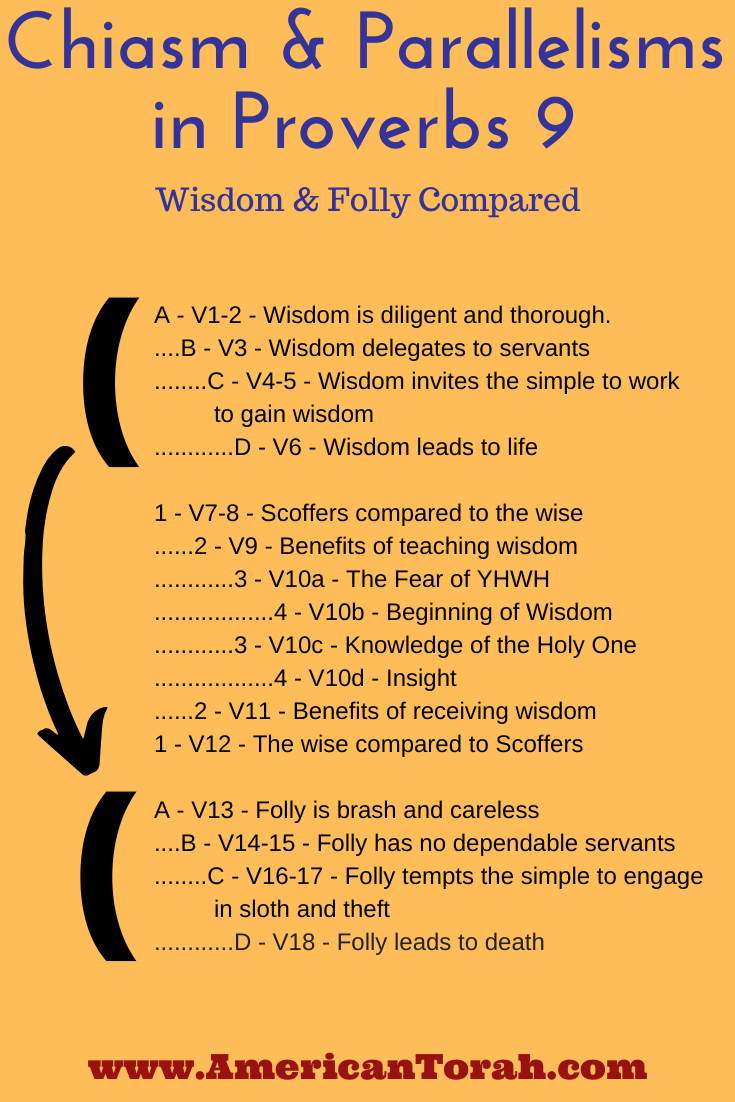
Proverbs 9 contains just such a structure. It is organized into three main parts:


  1. Parallelism Segment 1
  2. Central Chiasm centered on a parallelism
  3. Parallelism Segment 2


Verses 1-6 describe wisdom, personified as an industrious and generous woman. It's parallel in verses 13-18 describes folly, personified as a brash and lazy woman. Between the two parallel passages, is a chiasm on imparting and gaining wisdom, with yet another parallelism at its center.

Over at American Torah, I'm going to expand on this chapter and talk about what we can learn from the three divisions. I'll add links below.

On Wisdom


Multiple Chiasms in Joshua 23

The entirety of Joshua 23 is a chiasm.

A chiasm in Joshua 23:1-16 illustrates that God keeps his promises and expects us to keep ours too.


For more on chiasms--including how to identify, map, and interpret them--check out The Chiasm Course!

Did Miriam Author Part of the Bible?

There is an obvious chiasm in Exodus 1-2 in the story of Moses' birth and adoption into Pharaoh's house. The chiasm includes at least Exodus 1:22-2:9, and possibly as much as Exodus 1:5-2:15.

This image shows the clearest segment:


Here is the expanded chiasm, which I think is correct:

A .v8-19 - Egyptians oppress Hebrews. Midwives rescue. Answer demanded. Escape.
B ...v20-21 - God's favor on the Midwives and growth of their families.
C .....v22 - Pharaoh said, "Take the son away. Let the daughter live."
D .......v1 - Amram went and took his wife, Jochebed.
E .........v2 - Jochebed conceived and bore a son.
F ...........v2 - Jochebed saw that the child was fine, took pity on him, and hid him for 3 months.
G .............v3 - Jochebed went to the river and hid the child in a basket in the river.
H ...............v4 - Miriam stood at a distance to learn what would happen.
G .............v5 - The princess went to the river and found the basket in the river.
F ...........v6 - The princess revealed the child, saw him crying, took pity, and recognized him.
E .........v7 - Miriam found a woman who had born a child.
D .......v8 - Miram went and called the child's mother, Jochebed.
C .....v9 - The princess said, "Take the child away. Pay the woman her wages."
B ...v10-11a - The princess's favor on Moses and his growth into a man.
A .v11b-15 - Egyptians oppress Hebrews. Moses rescues. Answer demanded. Escape.

Chiasms are always fascinating. The most interesting part is usually at the center, and this one is no exception. Miriam is at the center of a chiasm on the birth, near death, and adoption of Moses, and not just Miriam, but her observing and studying the process of Moses' transformation from Hebrew to Egyptian and back again to Hebrew.

What does this mean?

It probably means that Miriam was the source of the first part of Exodus; it might even record her exact words. How do we know what happened with the midwives and Jochebed and the basket and Pharaoh's daughter? Miriam witnessed it all so that Moses could his story as seen through her eyes and possibly even her words.

Knowledgeable Bible students will recall that this isn't the only extended record of Miriam's words. Exodus 15:1-21 contains The Song of Miriam.

Chiasm in Leviticus 24 on the Justice Required for Blasphemy, Injury, and Murder


A>V13 - YHWH spoke to Moses
B>>>V14 - Bring the man out of the camp and stone him
C>>>>>V15 - Speak to the people (whoever curses God… whoever blasphemes God…)
D>>>>>>>V16 - Same for sojourner and native
E>>>>>>>>>V17 - Whoever takes a human life
F>>>>>>>>>>>V18 - Whoever takes an animal’s life
G>>>>>>>>>>>>>V19 - Whoever injures his neighbor
H>>>>>>>>>>>>>>>V20a - Fracture for fracture
I>>>>>>>>>>>>>>>>>V20b - Eye for eye
H>>>>>>>>>>>>>>>V20c - Tooth for tooth
G>>>>>>>>>>>>>V20d - Whatever injury he gives a person
F>>>>>>>>>>>V21a - Whoever kills an animal
E>>>>>>>>>V21b - Whoever kills a person
D>>>>>>>V22 - Same for sojourner and native
C>>>>>V23a - Moses spoke to the people of Israel
B>>>V23b - They brought the man out of the camp and stoned him
A>V23c - The people did as YHWH commanded Moses

This chiasm highlights the principle of man as the image of God. Murder and injury to your neighbor is an assault on the very image of God. The punishment is to be commensurate with the crime (the meaning of "eye for eye and tooth for tooth"), which is why the punishment for intentional blasphemy against God is death. His name is that much higher, that much holier than the name of a man.

Chiasm in the betrayal of Yeshua by Yehudah


  • V1 – Feast of Unleavened Bread drew near, called Passover
    • V2 – Priests and scribes wanted to kill Yeshua, but feared the people
      • V3 – Satan entered (filled?) Judas, one of the twelve
        • V4 – Judas met with the priests about betraying Yeshua
      • V5 – The priests filled with gladness, agreed to give him money
    • V6 – Judas wanted to betray Jesus, but feared the people
  • V7 – The day of unleavened bread arrived, when the Passover is to be killed