Showing posts with label Parallelism. Show all posts

Triple Parallelism in a Chiasm in Genesis 9:12-17


·         V12 - This is the sign of the covenant between me and you and all living creatures with you

o   V13 - Set bow in the cloud

§  Sign of the covenant between me and the earth

o   V14 - When I bring clouds and bow is seen

§  V15 - I will remember my covenant between me, you, and all kinds of living flesh

o   V16 - When the bow is in the clouds and seen

§  I will remember the covenant between God and all kinds of living flesh on the earth

·         V17 - This is the sign of the covenant between me and all flesh on the earth


Parallelism in Matthew 21 on the Authority of Yeshua and His Disciples


  • V1 - Yeshua approaches Jerusalem via House of Unripe Figs
    • V2-7 - Yeshua claims authority over Jerusalem
      • V8-11 - Jerusalem acknowledges his authority
    • V12-13 - Yeshua claims authority over Temple
      • V14-16 - People acknowledge his authority over Temple
  • V17 - Returns from House of Dates via House of Unripe Figs
    • V18-19 - Yeshua has authority over fruit of Jerusalem
      • V20-22 - Disciples have authority over mount Zion
    • V23-25 - Yeshua's authority questioned by the priests
      • V26-27 - Priests' authority threatened by people & Yeshua
Bethphage was between Bethany and Jerusalem. The first time Yeshua entered Jerusalem in v1, he was coming from Jericho. The second time in v17, he was coming from Bethany, but both times he had to pass through Bethphage, even though the second half of the narrative doesn't make that explicit.

Bethphage means "house of unripe figs" and Bethany means either "house of dates" or "house of misery". Since fruit figures prominently in this story and literary structure, I suspect that Matthew and Yeshua mean for us to understand it as "house of dates".

Notice that both halves of the parallelism follow this pattern:
1. Approaching Jerusalem
2. Authority over Jerusalem/Zion
3. Authority over the Temple/Priesthood

By entering Jerusalem the way he did, seated on the donkey, Yeshua claimed to be a deliverer and King of Israel. By sitting on the cloaks of the Twelve Disciples and accepting the accolades, cloaks, and palm branches of the people, he also accepted the submission of the people of Jerusalem to his authority. He then entered the Temple and asserted his authority there by driving out the merchants and money changers and reasserting its intended role as a house of prayer for all nations. In turn, the people again acknowledge his authority by bringing their sick for healing and crying out "Hosanna to the Son of David!" 

In the second half of the parallelism, Yeshua repeats his assertion of authority over Zion by inspecting the fruit of the land and cursing an unproductive tree. Even though this was spring time and well before the season for ripe figs, there should at least have been immature fruit buds forming. (Based on my personal experience with fig trees in my yard, which I admit are not the same variety and might behave differently.) This tree might represent the people of Israel outside of Jerusalem, but I believe it is much more likely that it represents the religious leadership of Judah, which he was replacing with the Twelve Disciples.

Yeshua caused the Sadducees and Pharisees to wither away and he destroyed the Temple to keep them from continuing to defile it. In historical terms, this withering happened almost immediately, about 40 years later. In their stead, he appointed the Disciples to leadership over the people, evidenced by using their cloaks as a saddle on the donkey which, in turn, rode over the cloaks of Jerusalem. (See 2 Kings 9:1-13.) The disciples didn't become a replacement priesthood, but they did take over as God's national teachers and judges.

Two related resources:


Video teaching on Yeshua's Triumphal Entry, the two donkeys, and the coats and palm branches...

Chiasm on Healing on the Sabbath in Matthew 12:9-14

 This chiasm in Matthew 12:9-14 is centered on the moral hierarchy implied by the fact that the Sabbath was made for man, not man for the Sabbath.


  • V9 - Yeshua went on and entered the synagogue
    • V10 - Man with a withered hand
      • They asked “Is it lawful to heal on the Sabbath?”
        • V11 - You will rescue a sheep on the Sabbath.
        • V12 - You should rescue a man on the Sabbath.
      • V13 - He said, “Stretch out your hand.”
    • The man’s hand is healed
  • V14 - The Pharisees went out and conspired to destroy him

Since the Sabbath was created to restore mankind, it should never be used to prevent that restoration. The Sabbath command of Exodus 20 also implies that the Sabbath was created to restore man's animals.

I found this chiasm during a demonstration at Common Sense Bible Study, but I later realized that it was a much simpler structure than I had initially thought.

For more on chiasms--including how to identify, map, and interpret them--check out The Chiasm Course!

A Chiasm in Matthew 5 on the Spiritual Nature of the Law


A - v2-12 - Spiritual application of Torah
-- B - v13-16 - Righteousness that glorifies God
---- C - v17a - Don't think that Yeshua will abolish the Law or Prophets
------ D - v17b - Yeshua didn't come to abolish them
-------- E - v18a - Until Heaven and Earth pass away
---------- F - v18b - Not an iota or dot will pass from the Law
-------- E - v18c - Until all is accomplished
------ D - v19a - Relaxes the least commandment and teaches others so
---- C - v19b - Does and teaches the commandments
-- B - v20 - Righteousness that glorifies man
A - v21-48 - Spiritual application of Torah

A few things that can be learned from this chiastic arrangement:

  1. "Until Heaven and Earth pass away" and "Until all is accomplished" are not two possibilities for when the Law will pass away, but two descriptions of the same event. In other words "all" will not be accomplished until heaven and earth pass away.
  2. Verses 13-16 are meant to exemplify a kind of righteous behavior that glorifies God. This righteousness is juxtaposed with that of the scribes and Pharisees in verse 20, which serves only to glorify men.
  3. The Beatitudes in verses 2-12 concern the inner character of the perfectly righteous man, while the "You have heard it said" statements in verses 21-48 are specific instructions on how to become that righteous man. Both sets of statements are examples of literary anaphora, a form of parallelism in which the first word or phrase is repeated in each statement in order to connect them together.
  4. Verses 17-20 are usually treated as a discrete passage with a complete message in itself, but this misunderstands Yeshua's real message. The Beatitudes are Torah. Letting the light of your righteous deeds shine before men in order to glorify your Heavenly Father is Torah. So long as there is a need for peacekeepers, for mercy, for endurance of persecution, there is a need for the Law. Only when the need for those qualities has vanished--when wickedness, covetousness, and hatred have been abolished--will the Torah, also known as the Law of Moses, no longer be necessary to teach and convict mankind.

For more on chiasms--including how to identify, map, and interpret them--check out The Chiasm Course!

Chiasm and Parallelism in Deuteronomy 9:26-29


Deuteronomy 9:26-29 – A parallelism in a chiasm on God's faithfulness to the covenant

  • V26 - Don't destroy your people and heritage, whom you redeemed through greatness and a mighty hand
    • V27 - Remember the Covenant with Abraham, Isaac, and Jacob
      • Forget the sins of this people
    • V28 - YHWH wasn't able to keep his Covenant
      • He hated and destroyed the people
  • V29 - They are your people and heritage, whom you brought out with great power and an outstretched arm

God keeps his promises and he wants to hear us remind him of it. When it looks like God has forgotten or rejected you, he might just be waiting for you to tell him that you believe in him and trust him to keep his promises.

Parallelisms, Chiasms, and Proverbs 9

A parallelism is a literary structure in which two or more series of statements are set next to each other for comparison or contrast. It's a very common poetic device used in Hebrew literature. Sometimes an author will arrange his text in a parallelism only for the poetic effect, but sometimes it's also to lead the reader to a deeper, implied meaning. The Bible is full of parallelisms, more so in some texts like the Psalms than others, like the books of the Kings.

A Sample Parallelism

  • Statement 1
    • Statement 2
  • Statement related to 1
    • Statement related to 2


A chiasm is another literary structure that juxtaposes two series of statements, words, or ideas, but in a chiasm, the second series is in reverse order. Frequently--but not always--there is a central point, like an axis. Chiasms are common throughout the Bible, but not as common as parallelisms.

A Sample Chiasm

  • Statement 1
    • Statement 2
      • Central point
    • Statement related to 2
  • Statement related to 1


I have a growing list of Biblical chiasms and parallelisms here.

Things get really exciting when these literary structures overlap or are embedded within each other.

A Chiasm Embedded in a Parallelism

  • Statement 1
    • Statement 2a
      • Statement 2b
    • Statement related to 2a
  • Statement related to 1
    • Statement 2c
      • Statement 2d
    • Statement related to 2c


Chiasms can be embedded within chiasms or parallelisms, and vice versa.

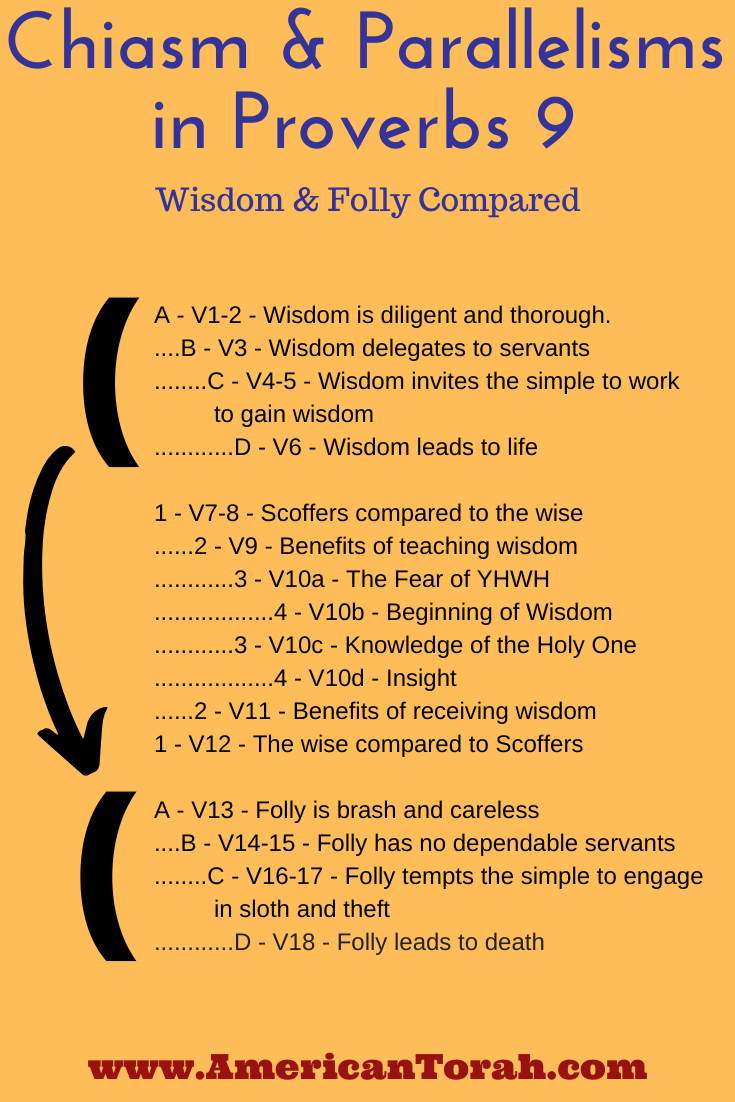
Proverbs 9 contains just such a structure. It is organized into three main parts:


  1. Parallelism Segment 1
  2. Central Chiasm centered on a parallelism
  3. Parallelism Segment 2


Verses 1-6 describe wisdom, personified as an industrious and generous woman. It's parallel in verses 13-18 describes folly, personified as a brash and lazy woman. Between the two parallel passages, is a chiasm on imparting and gaining wisdom, with yet another parallelism at its center.

Over at American Torah, I'm going to expand on this chapter and talk about what we can learn from the three divisions. I'll add links below.

On Wisdom


Parallelism in Genesis 12:11-17


  • V11 – When Abram was about to enter Egypt
    • He said, “You are a beautiful woman.”
      • V12 – Egyptians will say, “This is his wife.”
        • They will kill me and let you live
          • V13 – Say you’re my sister so it will go well
            • I will be spared for your sake
  • V14 – Abram entered Egypt
    • Egyptians saw she was beautiful
      • V15 – They praised her to Pharaoh
        • Sarai taken into Pharaoh’s house
          • V16 – For her sake, Pharaoh dealt well with Abram
            • V17 – Pharaoh was not spared for her sake, but Abram was


Parallelism in Genesis 12-14


  • 12:1-2 – Promise of land and descendants
    • 12:4 – Abram commanded to move
      • 12:6 – Abram went to the oak of Moreh at Shechem
        • 12:7 – Built an altar
          • 12:11-20 – Conflict with a king, Sarai taken and returned, wealth obtained
  • 13:14-16 – Promise of land and descendants
    • 13:17 – Abram commanded to move
      • 13:18 – Abram went to the oaks of Mamre at Hebron
        • 13:18 – Built an altar
          • 14:1-24 – Conflict with kings, Lot taken and returned, wealth refused
Interestingly, this parallelism overlaps a chiasm in Genesis 12:6-13:18. See here.

A Chiasm & A Parallelism in Deuteronomy 26:14


The small chiasm in Deuteronomy 26:14 concerns bringing tithes of the land to God and ensuring that those tithes are brought in a condition that honors God and can be accepted by him.

  • I have not eaten of my tithes while in mourning (for the dead)
    • I have not stored away any of these tithes while unclean
  • I have not given any of my tithes for the dead

Spiritual uncleanness results from contact with death, whether through the loss of life force (e.g. menstruation and other sexual discharges and dysfunctions), through the loss of life itself (e.g. physical contact with the dead or their graves), or through spiritual association with death (e.g. ancestor worship, necromancy, and the honoring of false gods). This is why uncleanness is sandwiched between mourning and death. Anything dedicated to God should not be contaminated with unclean things and activities, not because they are sinful--some are and some aren't--but because God is most holy.

Uncleanness is the opposite of holy. It interferes with our spiritual communion with him, which is a possible reason that God says the flesh of pigs and other unclean animals is abhorrent to him and ought to be to us. He likes to spend time with us and spiritual uncleanness gets in the way.

This chiasm is immediately followed by a couplet (a simple, 2-part parallelism):

  • I have hearkened 
    • To the voice of God
  • I have done
    • What God has commanded
To truly hear God is to obey. It doesn't matter if what God says makes sense to us or not. He always has reasons, and he is under no obligation to explain them to us. Our job is to trust him and to love him, and both trust and love require obedience to his commands. If God doesn't want his tithes tainted with death and mourning, then we need to make sure we give cheerfully and without reference to the dead.

Not even to the "sainted" dead.

For more on chiasms--including how to identify, map, and interpret them--check out The Chiasm Course!

Psalm 107 and the Grand Finale

A reader pointed out to me that Psalm 107 contains this really neat parallelism:


The pattern established in four parallelisms (v1-7, v8-14, v15-20, v21-30) is

A - Thank God for all the good things he does.
B - Ungrateful people get into trouble, but...
C - If they humble themselves and repent
D - God delivers them from trouble and brings them to a better place.

In the conclusion, the Psalmist changes it around a little:

v31-32 - Thank God for all the good things he does.
v33-34 - God can turn good things bad.
v35-38 - God can turn bad things good.
v39 - When bad things happen to good people
v40-41 - God turns it around so that all things work to good for those who believe in him.
v42 - Righteous people see this and give thanks to God in all circumstances. Wicked people ought to just keep silence lest things get even worse for them.
v43 - The wise will understand without having to see it in action and will meditate on the enduring love of God.

The same elements are present in the conclusion as in the preceding parallelism, except for one: The ungrateful people who get themselves into trouble. They are there by implication (the princes in v40 and the wicked in v42), but their doubt and foolishness isn't described explicitly.

Maybe the Psalmist's point in leaving that out of the final stanza is that eventually the pattern of sin and restoration comes to an end. The righteous will be permanently elevated and the wicked will come to a permanent end.

Past Failures Are No Barrier to Future Success

There's a chiasm in Exodus 6:10-30 centered on the tribes of Reuben, Simeon, and Levi.


When God told Moses to speak to Pharaoh, Moses objected that he was a man of "uncircumcised lips," as if God didn't know what He was doing. God still used him to set His people free from Egypt. Centuries earlier, Reuben, Simeon, and Levi had disqualified themselves from the family role of Firstborn through terrible behavior, yet God still used them to found three of the twelve tribes of Israel. 

It doesn't matter what you've done or said. It doesn't matter what you think you can or can't do. God still has a use for you. There is a place for you in His Kingdom. Don't think so highly of yourself that you could ever do anything to thwart God's plans.


  • V10-11 - God told Moses to speak to Pharaoh
  • V12 - Moses’ uncircumcised lips
    • V13 - God told Moses and Aaron to bring Israel out of Egypt
      • V14a - These are the heads of their fathers’ houses
        • 14b-25a - The children of Reuben, Simeon, and Levi
      • V25b - These are the heads of the fathers’ houses of the Levites
    • V26-27 - God told Moses and Aaron to bring Israel out of Egypt
  • V28-29 - God told Moses to speak to Pharaoh
  • V30 - Moses’ uncircumcised lips

Paired Parallelisms in Genesis 44:16


Who are we to tell God that we are innocent? He is our Creator, our Judge, and our Vindicator. No matter what we might think of ourselves, He knows our hearts, and He knows what constitutes guilt and innocence. He has said there is no innocence apart from Yeshua and we have no recourse but to accept His divine judgment. Rail against the wind all you like, tell it you're a "good person", but unless you turn to Yeshua and repent of your sins (yes, you have sins), you are lost. We are His servants, and that is the end of the story.

I'll be sending more on this verse in my newsletter later today (12/30/2016). Subscribe here: American Torah.

Multiple Chiasms and Parallelisms in Exodus 33


God made us so good at spotting patterns that sometimes we see them when they aren't there. I have to wonder if this might be one of those times. Although the presence of patterns in this passage is certain, I am less confident that I have diagrammed them correctly.

A Chiasm in Exodus 33:7

  • And Moses took the tabernacle and pitched it outside the camp, far off from the camp. 
    • And he called it the tabernacle of the congregation. 
  • And it happened that everyone seeking Jehovah went to the tabernacle of the congregation which was outside the camp.

A Chiasm in Exodus 33:8

  • And it happened as Moses went to the tabernacle, 
    • the people all rose and stood, each one at the door of his tent.
  • And they looked after Moses until he had gone into the tabernacle. 

A Parallelism in Exodus 33:9-11a

  • And it happened as Moses went into the tabernacle, 
    • the pillar of cloud would come down and stand at the door of the tabernacle. 
      • And He spoke with Moses. 
  • And all the people would see the pillar of the cloud standing at the door of the tabernacle. 
    • And all the people rose and bowed themselves, each one at the door of his tent. 
      • And Jehovah would speak to Moses face to face, as a man speaks to his friend.

A Chiasm in Exodus 33:11b-12a

  • And he would return to the camp. And his attendant, Joshua the son of Nun, a young man, did not leave the middle of the tabernacle. 
    • And Moses said to Jehovah, Behold, 
    • You are saying to me, Cause this people to go up.
  •  And You, You have not told me whom You will send with me. 

A Chiasm in Exodus 33:12b-17

  • And yet You have said, I know you by name, and 
    • also you have found favor in My eyes. And now, if I have found favor in Your eyes, please make me see Your ways, and let me know You, so that I may find favor in Your eyes; and consider that this nation is Your people. 
      • And He said, My presence will go with you, and I will give you rest. 
      • And they said to Him, If Your presence does not go, do not cause us to go up from here. 
    • And now by what can it be known that I and Your people have found favor in Your eyes? Is it not in Your going with us? And we are distinguished, I and Your people, from all the nations which are on the face of the earth? And Jehovah said to Moses, This thing which you have spoken I will do. For you have found favor in My eyes, and 
  • I know you by name. 

A Chiasm in Exodus 33:18-23

  • And he said, I pray, let me see Your glory. 
    • And He said, I will cause all My goodness to pass before your face. And I will call out the name of Jehovah before your face. 
      • And I will be gracious to whom I will be gracious, and I will have mercy on whom I will have mercy. 
    • And He said, You are not able to see My face; for no man can see Me and live. And Jehovah said, Behold, a place by Me! And you shall stand on a rock. 
  • And as My glory is passing it will be that I will put you in a cleft of the rock; and I will cover My hand over you during My passing. And I will remove My hand, and you shall see My back; but My face cannot be seen.

The Briefest Introduction to Chiasms


The Bible is full of chiasms (kai'-a-zumz), literary structures used to provide a framework to a story--what a novelist might call a story arc--or to convey additional meaning to what is contained by the bare text. The singular is technically chiasmus and the plural is chiasmi, since the word is derived from Greek and Latin. Since I speak English, I prefer chiasm/chiasms. In a chiasm, a series of phrases or concepts in the first half of the narrative are mirrored in the second half, usually--but not always--with one, unmirrored statement at the center.

Chiasms were used extensively by writers in many ancient cultures, and sometimes they are still used today, especially in poetry and song. Along with parallelisms, thematic allusions, Hebrew word play, and a number of other literary devices, chiasms can give fascinating insight on the meaning that the original Biblical writers intended to convey. They can be as short as a single verse or span multiple books. Most commonly they span a few verses or a chapter.

A typical chiasm might look something like this:

A - God speaks to prophet
  B - Prophet speaks to people
    C - People respond to man
      D - God acts
    C - People respond to God
  B - People speak to prophet
A - Prophet speaks to God

Sometimes they are very easy to see, but often they are obscured by translation from Hebrew or by artificial chapter and verse divisions. Being able to read the Hebrew (which I cannot), definitely makes them easier to find. Tony Robinson has a lot of great teaching on chiasms and thematic connections in Scripture. You can check them out here: Restoration of Torah Ministries.

And I have a growing list of them here: Index of Biblical Chiasmi and Parallelisms.

If you want to learn how to find and understand Biblical chiasms for yourself, check out The Chiasm Course!

Oppressing the Oppresser

This parallelism in Joel 3:19-21 illustrates the principle at work in Deuteronomy 19:19, which says regarding a false accuser, "You shall do to him as he had meant to do to his brother. So you shall purge the evil from your midst."

Egypt and Edom attacked Judah and Jerusalem without cause, but God turned their violence back on them and multiplied it.

Egypt and EdomJudah and Jerusalem
V19 – Egypt shall become a desolationV20 – Judah shall be inhabited forever
…and Edom a desolate wilderness…and Jerusalem to all generations
…for violence done to JudahV21 – I will avenge their blood
…because they shed innocent blood…because YHWH dwells in Zion

Lest Egypt's punishment seem overly harsh, remember who created whom. Who is the potter and who is the clay?

An Index of Biblical Chiasmi and Parallelisms


This list isn't even close to exhaustive. I'll add to it as time goes on. If you want more, there are other lists on the Internet. Just search for "chiasm" or any variation thereof.

If you want to learn how to find and understand Biblical chiasms for yourself, check out The Chiasm Course!


Click here for a brief introduction to chiasms.

- Genesis 1:5, Chiasm
- Genesis 1:9-10, Chiasm
- Genesis 2:4, Chiasm
- Genesis 2:9, Chiasm
- Genesis 2:15-3:7, Chiasm
- Genesis 6:8-9, Chiasm
- Genesis 6:10-9:19, Chiasm
- Genesis 6-9 & 18-19, Parallelism
- Genesis 6:11-13, Parallelism
- Genesis 6:18-7:24, Parallelism
- Genesis 7:16-8:6, Chiasm
- Genesis 7:20-24, Chiasm
- Genesis 8:22, Chiasm
- Genesis 9:1-9:7, Chiasm
- Genesis 9:6, Chiasm
- Genesis 9:12-17, Both
- Genesis 10:22-11:26, Chiasm
- Genesis 11:8-9, Chiasm
- Genesis 12-14, Parallelism
- Genesis 12:10-11, Chiasm
- Genesis 12:11-17, Parallelism
- Genesis 12:6-13:18, Chiasm
- Genesis 17:1-17, Chiasm
- Genesis 17:10-11, Chiasm
- Genesis 17:12-13, Chiasm
- Genesis 17:22-18:1, Chiasm
- Genesis 21:13-21, Chiasm
- Genesis 22:16-18, Chiasm
- Genesis 27:18-32, Chiasm
- Genesis 28:10-32:2, Chiasm
- Genesis 31:1-2, Parallelism
- Genesis 37-50, Chiasm
- Genesis 42:15-20, Chiasm
- Genesis 44:16, Parallelism
- Genesis 44:18-45:15, Chiasm
- Genesis 45:18-20, Parallelism
- Genesis 47:2-20, Chiasm
- Exodus 1:8-2:15, Chiasm
- Exodus 2:11, Chiasm
- Exodus 2:23-3:9, Chiasm
- Exodus 4:14-31, Chiasm
- Exodus 6:2-8, Chiasm
- Exodus 6:6-8, Chiasm
- Exodus 6:10-30, Chiasm
- Exodus 6:26-27, Chiasm
- Exodus 12:18-22, Chiasm
- Exodus 12:27, Chiasm
- Exodus 13:1-16, Parallelism
- Exodus 13:2-12, Chiasm
- Exodus 13:13-18, Chiasm
- Exodus 15:22-16:4, Parallelism
- Exodus 15:23, Chiasm
- Exodus 15:25-26, Chiasm
- Exodus 18:1-11, Chiasm
- Exodus 18:10, Chiasm
- Exodus 18:11, Chiasm
- Exodus 19:5 - Leviticus 27, Chiasm
- Exodus 19:20, Chiasm
- Exodus 20:8-11, ?
- Exodus 21:12-14, Chiasm
- Exodus 21:12-17, Parallelism
- Exodus 25:1-27:21, Chiasm
- Exodus 25-40, Chiasm
- Exodus 31:12-18, Chiasm
- Exodus 31:16-35:3, Chiasm
- Exodus 33:7, Chiasm
- Exodus 33:8, Chiasm
- Exodus 33:9-11a, Chiasm
- Exodus 33:11b-12a, Chiasm
- Exodus 33:12b-17, Chiasm
- Exodus 33:18-23, Chiasm
- Exodus 39:43, Chiasm
- Leviticus 1-27, Chiasm
- Leviticus 6:12-13, Chiasm
- Leviticus 8:1-5, Chiasm
- Leviticus 15:2-12, Chiasm
- Leviticus 15:2-33, Chiasm
- Leviticus 19:3-30, Chiasm
- Leviticus 19:3-36, Parallelism
- Leviticus 23:9-22, Both
- Leviticus 23:33-43, Chiasm
- Leviticus 24:13-23, Chiasm
- Leviticus 26:1-46, Chiasm
- Leviticus 26:34-35, Parallelism
- Numbers 3:2-3, Chiasm
- Numbers 3:12-41, Chiasm
- Numbers 4:1-49, Parallelism
- Numbers 4:1-7:88, Chiasm
- Numbers 4:49, Chiasm
- Numbers 7:1-88, Parallelism
- Numbers 7:10, Chiasm
- Numbers 9:17-23, Parallelism
- Numbers 22:3, Parallelism
- Numbers 28:1-8, Chiasm
- Numbers 30:1-16, Chiasm
- Deuteronomy 4:15-31, Chiasm
- Deuteronomy 8:7-9, Chiasm
- Deuteronomy 9:3-16, Chiasm
- Deuteronomy 9:26-29, Chiasm
- Deuteronomy 12, Both
- Deuteronomy 14:29-15:18, Parallelism
- Deuteronomy 16:9-20, Chiasm
- Deuteronomy 16:16-17:12, Both
- Deuteronomy 18:1-2, Parallelism
- Deuteronomy 20-21, Parallelism
- Deuteronomy 22:13-29, Chiasm
- Deuteronomy 26:1-2, Chiasm
- Deuteronomy 26:1-4, Parallelism
- Deuteronomy 26:3-10, Parallelism
- Deuteronomy 26:14, Chiasm
- Deuteronomy 27:1-10, Chiasm
- Deuteronomy 28:2-7, Chiasm
- Deuteronomy 28:8-11, Chiasm
- Deuteronomy 28:20-48, Chiasm
- Deuteronomy 29:8-13, Chiasm
- Deuteronomy 31, Chiasm
- Joshua 1:1-11, Chiasm
- Joshua 2:3-7, Chiasm
- Joshua 4:2-4, Chiasm
- Joshua 4:23-24, Chiasm
- Joshua 9:14-18, Chiasm
- Joshua 13:1-14:5, Chiasm
- Joshua 23:1-16, Chiasm
- Judges, Chiasm
- Judges 1:4-7, Parallelism
- Judges 6:1-8:32, Chiasm
- Judges 14:1-15:13 & 21:11-21:25, Chiasm
- 1 Samuel 17:58-18:5, Chiasm
- 2 Samuel 1:19-27, Chiasm
- 2 Samuel 18:33, Chiasm
- 2 Samuel 21-24, Chiasm
- 1 Kings 12:32-33, Chiasm
- 2 Kings 13:14-25, Chiasm
- Psalm 9:16, Parallelism
- Psalm 12:1-8, Chiasm
- Psalm 18:9-12, Parallelism
- Psalm 32, Chiasm
- Psalm 37, Chiasm
- Psalm 66, Chiasm
- Psalm 67, Chiasm
- Psalm 70, Chiasm
- Psalm 81, Chiasm
- Psalm 82, Chiasm
- Psalm 86:1-5, Parallelism
- Psalm 107, Parallelism
- Psalm 142:1, Parallelism
- Psalm 142:2, Chiasm
- Psalm 148, Parallelism
- Proverbs 3:1-12, Chiasm
- Proverbs 3:1-4, Parallelism
- Proverbs 3:5-8, Parallelism
- Proverbs 3:9-12, Parallelism
- Proverbs 4:18-19, Parallelism
- Proverbs 9, Parallelism/Chiasm
- Proverbs 9:7-9, Chiasm
- Proverbs 10:11, Chiasm
- Proverbs 10:16-17, Parallelism
- Proverbs 11:10-11, Parallelism
- Proverbs 12:5-6, Chiasm
- Proverbs 12:20, Chiasm
- Proverbs 15:5, Chiasm
- Proverbs 20:1-2, Parallelism
- Proverbs 29:5-6, Chiasm
- Jeremiah 17:19-21, Chiasm
- Isaiah 44:6-8, Chiasm
- Ezekiel 47:21-23, Parallelism
- Joel 3:9-13, Parallelism
- Joel 3:19-21, Parallelism
- Habakkuk 3:2-9, Chiasm
- Matthew 5, Chiasm
- Matthew 5:2-10, Chiasm
- Matthew 6:6-17, Chiasm
- Matthew 6:24, Chiasm
- Matthew 6:25-31, Chiasm
- Matthew 11:21-24, Parallelism
- Matthew 11:29-30, Chiasm
- Matthew 12:9-14, Chiasm
- Matthew 12:41-42, Parallelism
- Matthew 19:5-6, Chiasm
- Matthew 21:1-27, Parallelism
- Matthew 23:12, Chiasm
- Matthew 26:30-50, Parallelism
- Mark 5:22-42, Chiasm
- Mark 6:5-13, Chiasm
- Mark 11, Chiasm
- Mark 12:9-14, Both
- Mark 12:41-42, Parallelism
- Mark 14:27-46, Chiasm
- Luke 19:1-20:26, Chiasm
- Luke 22:1-7, Chiasm
- Luke 22:31-62, Chiasm
- John 1:1-18, Chiasm
- John 1:10-11, Parallelism
- John 3:31, Chiasm
- John 4?, Parallelism
- John 4:46-54, Chiasm
- John 5:19-30, Chiasm
- John 11:1-7, Chiasm
- Acts 6:1-7, Chiasm
- Acts 9:2-3, Parallelism
- Romans 5:15-16, Parallelism
- Romans 5:17-19, Parallelism
- Romans 7:19-20, Chiasm
- Romans 8:12-17, Chiasm
- Ephesians 1:11-14, Parallelism
- 1 Timothy 6:3-21, Chiasm

The Many Faces of God

There's a parallelism in Ezekiel 28:22-36 that shows some of the attributes of the various faces that God shows us, depending on circumstances and our relationship to Him and His people.
Thus says the Lord GOD: Behold, I am against you, O Sidon, and I will manifest my glory in your midst. And they shall know that I am the LORD when I execute judgments in her and manifest my holiness in her; I will send pestilence into her, and blood into her streets; and the slain shall fall in her midst, by the sword that is against her on every side.

Then they will know that I am YHVH. (1)

And for the house of Israel there shall be no more a brier to prick or a thorn to hurt them among all their neighbors who have treated them with contempt.

Then they will know that I am the Adonai YHVH. (2)

Thus says the Lord GOD: When I gather the house of Israel from the peoples among whom they are scattered, and manifest my holiness in them in the sight of the nations, then they shall dwell in their own land that I gave to my servant Jacob. And they shall dwell securely in it, and they shall build houses and plant vineyards. They shall dwell securely, when I execute judgments upon all their neighbors who have treated them with contempt.

Then they will know that I am YHVH Elohim. (3)
 Notice how, in each statement, God changes how we will know him.

(1) YHVH is the God of relationship. He is Israel's husband, teacher, and protector. When Sidon abuses Israel, they answer to YHVH. Like any good husband when his wife is attacked, YHVH responds with even greater violence.

(2) Adonai means "lord" or "master", and when God says that Israel will know that He is Adonai YHVH, He is indicating that, not only will they know that He is their husband, but also that He is their master. Israel will never be free from persecution or danger by their own power, but only by the power of God. "Never again" ought to be a call to repentance, instead of to arms and activism.

(3) Elohim is the Creator and the Judge of all that He created. He has authority over all nations and lands because he created them. He scattered Israel among the nations and He will call them back again. He never forgot or lost them. He knows exactly where every one of His creations is hiding, and He will rescue or destroy them as He chooses.

A Chiasm Framed by 2 Parallelisms in Deut 16-17


Let every house keep the feasts focused on Jerusalem and as God prescribed, be very careful to ensure fair and objective justice for all people, and do not tolerate open idolatry among the people or the disease will even infect the most sacred place and function of the Temple. Whether in church or state, the people usually get the leadership they deserve.
  • Deuteronomy 16:16-17 – Parallelism A, part 1
    1. Three feasts every year
    2. Don’t appear empty-handed
    3. Every man give as he is able
    4. According to God’s blessings
    • Deuteronomy 16:18-20 – Parallelism B, part 1
      1. Appoint rulers in the towns God gives you
      2. Be very careful to follow justice and not pervert it
      3. You will live
      • Deuteronomy 16:21 – Don’t plant a sacred tree beside the altar
        • Deuteronomy 16:22 – Don’t set up a pillar
      • Deuteronomy 17:1 – Don’t sacrifice a blemished animal
    • Deuteronomy 17:2-5 – Parallelism B, part 2
      1. In the towns God gives you, someone has done evil
      2. Inquire diligently and convict only if judgment is certain
      3. The perpetrator will die
  • Deuteronomy 17:6-12 – Parallelism A, part 2
    1. Two or three witnesses
    2. By the hands of the witnesses
    3. If you are unable to judge
    4. The Cohanim will judge for you


A Chiasm Centered on the Sota


A: 4:1-48 – Parallelism in the census of the Levites
B: 4:49 – Levites chosen & blessed by God through Moses
C: 5:1-4 – Keeping a holy people holy
D: 5:5-10 – Restitution vow of consecration
E: 5:11-16 – Jealous husband puts his wife in God's hand
F: 5:17-24 – Water of blessing and curses / innocence and guilt
G: 5:25-26 – Grain offering removed from hand
F: 5:26-28 – Water of curse and blessings / guilt and innocence
E: 5:29-31 – Jealous husband puts his wife in God's hand
D: 6:1-5 – Nazirite vow of consecration
C: 6:6-21 – Keeping a holy people holy
B: 6:22-27 – Israel chosen & blessed by God through Aaron
A: 7:1-88 – Parallelism in the gifts of the chiefs


What exactly is this structure trying to tell us? Here's one idea, not guaranteed to be correct:

(A) God's people are to be set apart from the world. (B) We have His stamp on us, and we are to behave accordingly. (C) If, by purpose or chance, we fail, we must confess our sins and (D) make them right again. (E) If we believe that our sin is secret and God will never know or won't mind, we deceive ourselves. Our sins cannot be hidden from God or His chosen High Priest. (F) The Spirit will produce through us the fruit of our actions, whether they be for life or death. (G) In the end we will be judged by Him who was made the Firstfruits of the Resurrection and taken up to Heaven. If we have been faithful to confess our sins, to repent of them, and to make them right when we are able, He will be faithful to forgive us before the Father, and we will live. If we have been unfaithful, He will know and will judge us accordingly, also before the Father.

Further, there is a parallelism between chapters 4 and 7.

  • 4:1-33 – Commissioning the census and assignments
    • 4:34-45 – Taking the census
      • 4:46-49 – Summary of the census
  • 7:1-9 – Tribal chiefs bring gifts to aid the Levites in their assignments
    • 7:10-83 – A census of gifts the tribal chiefs brought for the altar
      • 7:84-88 – Summary of the gifts
So that the chiasm is framed by a parallelism.