Face Masks and Social Distancing

Defense in Depth
  • "the arrangement of defensive lines or fortifications so that they can defend each other."
  • "a concept used in Information security in which multiple layers of security controls are placed throughout an information technology system.

A network firewall filters all traffic coming in and out of a network and tries to prevent threats like hackers and viruses from getting onto the network. Each computer on the network has its own firewall that does the same thing in a different way. The computer also has software that checks websites for malicious code, scans files for known viruses, and actively watches the behavior of programs for anything suspicious. A military installation has fences, security cameras, and guards at the gates. Secure facilities within the base will have additional guards, access control using biometrics, passcodes, id cards, etc., and alarms. The personnel are trained to watch for suspicious activity and alert security or intervene when necessary. This is called "Defense in Depth". Everyone understands this concept intuitively. We use it while driving, in our personal safety, and even in our homes. No single element of defense is sufficient to prevent all attacks. In fact, it's impossible to stop *all* attacks. No security system will ever be perfect. However, each additional layer increases the odds that an attack will be stopped before it can do any serious harm. This is also the concept behind vaccines, face masks, social distancing, limited gatherings, etc.. Whether or not each of these layers is effective, necessary, or unintentionally harmful in some other way is another question altogether. As far as I'm concerned, it's all a waste of time, and we should just go about our lives as if this was a bad flu season. Protect the vulnerable, take reasonable precautions, and keep living. My point is that arguments like "If masks stop the virus, why do we have to stand 6' apart" are silly and they make you look silly when you use them.

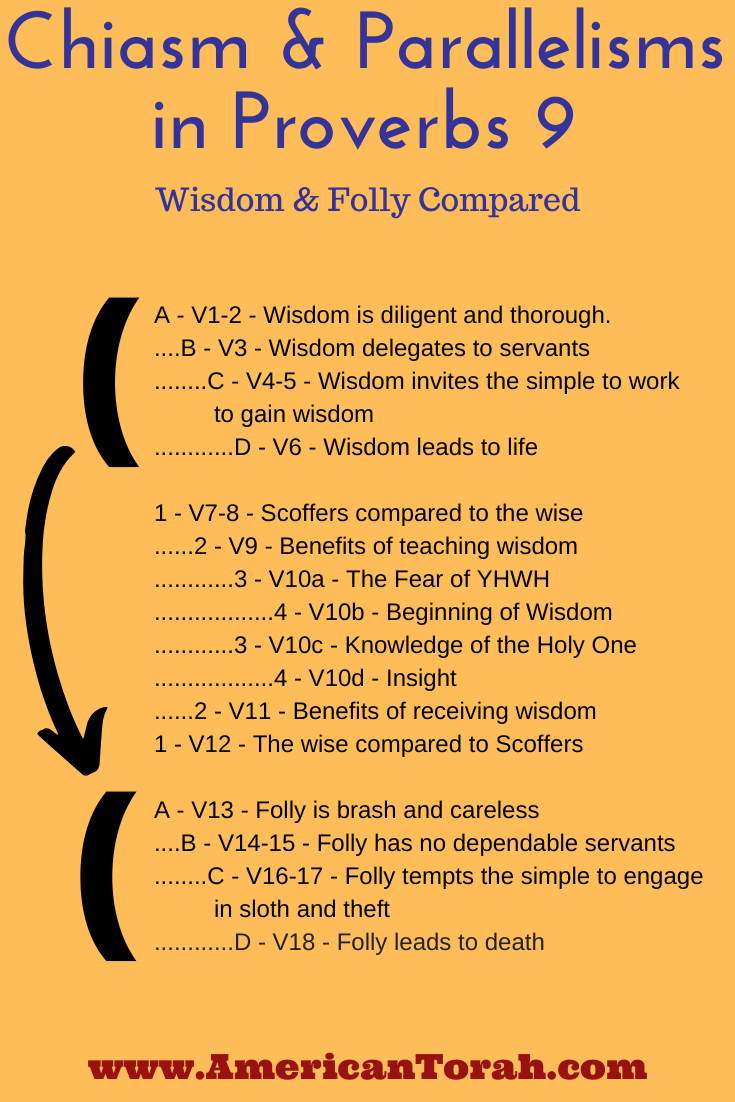
Parallelisms, Chiasms, and Proverbs 9

A parallelism is a literary structure in which two or more series of statements are set next to each other for comparison or contrast. It's a very common poetic device used in Hebrew literature. Sometimes an author will arrange his text in a parallelism only for the poetic effect, but sometimes it's also to lead the reader to a deeper, implied meaning. The Bible is full of parallelisms, more so in some texts like the Psalms than others, like the books of the Kings.

A Sample Parallelism

  • Statement 1
    • Statement 2
  • Statement related to 1
    • Statement related to 2


A chiasm is another literary structure that juxtaposes two series of statements, words, or ideas, but in a chiasm, the second series is in reverse order. Frequently--but not always--there is a central point, like an axis. Chiasms are common throughout the Bible, but not as common as parallelisms.

A Sample Chiasm

  • Statement 1
    • Statement 2
      • Central point
    • Statement related to 2
  • Statement related to 1


I have a growing list of Biblical chiasms and parallelisms here.

Things get really exciting when these literary structures overlap or are embedded within each other.

A Chiasm Embedded in a Parallelism

  • Statement 1
    • Statement 2a
      • Statement 2b
    • Statement related to 2a
  • Statement related to 1
    • Statement 2c
      • Statement 2d
    • Statement related to 2c


Chiasms can be embedded within chiasms or parallelisms, and vice versa.

Proverbs 9 contains just such a structure. It is organized into three main parts:


  1. Parallelism Segment 1
  2. Central Chiasm centered on a parallelism
  3. Parallelism Segment 2


Verses 1-6 describe wisdom, personified as an industrious and generous woman. It's parallel in verses 13-18 describes folly, personified as a brash and lazy woman. Between the two parallel passages, is a chiasm on imparting and gaining wisdom, with yet another parallelism at its center.

Over at American Torah, I'm going to expand on this chapter and talk about what we can learn from the three divisions. I'll add links below.

On Wisdom


Dr Harman on the Levitical Sacrifices

Dr. Terry Harman, aka The Tabernacle Man, has created some great videos about the 5 Levitical sacrifices in Leviticus 1-6. I would just point you to a playlist on Youtube, but some of the videos in this series are marked as "made for kids" (I think that was an accident), so Youtube won't let them be added to a playlist. So I'm putting them here instead!

Video 1: 5 Levitical Sacrifices Introduction

Video 2: Burnt Offering Leviticus 1

Video 3: Leviticus 2 Grain or Meal Offering

Video 4: Peace Offering Leviticus 3 part 1

Video 5: Peace Offering Leviticus 3 part 2

Video 6: Sin Offering Leviticus 4 part 1

Video 7: Sin Offering Leviticus 4 part 2
Video 8: Guilt Offering Leviticus 5

Moses & Yeshua, leading the way to God

In the traditional Torah reading schedule, 1 Kings 7:27-8:21 is read together with Exodus 38:21-40:38 (aka Pekudei).

Exodus 40:34-38

Even Moses, the man who spent 80 days talking to God on Sinai, could not go into the Holy Place when God’s presence was too strong. How much less are we able approach God directly? Moses (and the High Priest) was a type of the Messiah, Yeshua. Only they could approach God here on Earth, and even then not whenever they felt like it.

Since there is no Temple or Tabernacle here on earth now, Yeshua is our only High Priest in the Tabernacle in Heaven. He is the cover over the tabernacle of our hearts and our mediator before the Father, and, being infinitely greater than Moses, Yeshua is able to take us where the Law could not.

1 Kings 8:8-9

When the priests placed the Ark into the Temple for the first time, they pulled the staves part way out so they extended through the veil into the main sanctuary. This either indicates that the staves were not parallel with the veil as in most depictions, but perpendicular. When the Ark was carried in the wilderness and into battle, God’s throne could face either forward or back towards the people.

It was probably very dark behind the veil, and the priest might have used the staves to feel his way to the Ark. Alternatively, their position could represent how God reaches through the veil to us, because we cannot reach through it to him. I prefer the latter explanation, but I don’t know what is correct.

Another interesting thing is that Kings says only the two tablets of the Law were in the Ark at this time. It could be that the Philistines removed the rod and the pot of manna when the Ark was in their possession, or it could be that those things were never in the Ark at all. Some believe that they were placed before the Ark instead of inside of it. In a way that makes much more sense, since the Ark was quite short compared to a walking or shepherd’s staff as Aaron’s must have been. The idea that the rod represents God’s authority and guidance, while the manna represents God’s providence is not harmed either way. They are in our hearts with God’s Law or they are before our hearts, while the interior is reserved as a special place for the Law. Either way works for me.

The Age of the Books of the Bible


This is a list of the books of the Bible in the approximate order in which they were written. I say "approximate" because there are three factors that greatly complicate such a list:

  1. Nobody knows exactly when most books were written.
  2. There is much disagreement about when most books were written, with opinions differing by many centuries at times.
  3. Some books were written over the course of many centuries, being compilations of oral histories and records from different sources, and even being edited or updated by later authors.
Order: The order in which the book appears in the standard Protestant Bible.
Name: The commonly understood name.
Author: The traditional, primary, and/or probable author(s). Some books were written by multiple authors and others were edited, translated, or compiled by a later scribe, like Ezra, working from a collection of manuscripts or oral traditions.
Subject Period: The period of time covered by the books contents. Like the date of authorship, the subject period is a fuzzy concept for many books. Some books combine historical narrative with prophecy of the future (Isaiah, for example), and the precise subject period of prophecy is always up for interpretation.
Written: The approximate period of time in which the book was written. Some books, like the Psalms, were written over vast periods of time and other books are of very uncertain date, so their placement in the list is fuzzy, to say the least.

OrderNameAuthor(s)Subject PeriodWritten
1 GenesisMoses4000-1600 BC2000-1400 BC
2 ExodusMoses1600-1400 BC1600-1400 BC
3 LeviticusMoses1600-1400 BC1600-1400 BC
4 NumbersMoses1600-1400 BC1600-1400 BC
5 DeuteronomyMoses, Joshua1600-1400 BC1600-1400 BC
6 JoshuaJoshua, Phinehas1500-1300 BC1500-1300 BC
7 JudgesSamuel/Unknown1500-1000 BC1400-900 BC
8 RuthUnknown1100-1000 BC1050-900 BC
9 1 SamuelSamuel, Nathan, Gad, Jeremiah, Unknown1000-700 BC1000-500 BC
10 2 SamuelSamuel, Nathan, Gad, Jeremiah, Unknown1000-700 BC1000-500 BC
19 PsalmsDavid, Asaph, et al1600-400 BC1600-400 BC
22 Song of SolomonSolomon1000-950 BC1000-900 BC
20 ProverbsSolomon, Agur/Hezekiah, Lemuel1000-700 BC1000-700 BC
18 JobUnknown2000-1500 BC1000-500 BC
21 EcclesiastesSolomon950-900 BC950-900 BC
31 ObadiahObadiahProphetic900-550 BC
29 JoelJoelProphetic850-600 BC
32 JonahJonah800-750 BC800-750 BC
30 AmosAmosProphetic800-725 BC
28 HoseaHoseaProphetic750-700 BC
33 MicahMicahProphetic750-700 BC
23 IsaiahIsaiah and compiler700-500 BC700-500 BC
34 NahumNahumProphetic650-600 BC
35 HabakkukHabakkukProphetic650-600 BC
36 ZephaniahZephaniahProphetic650-600 BC
11 1 KingsJeremiah/Unknown950 BC-850 BC650-570 BC
12 2 KingsJeremiah/Unknown855 BC-560 BC650-570 BC
24 JeremiahJeremiah and compilerProphetic600-550 BC
26 EzekielEzekielProphetic600-550 BC
25 LamentationsJeremiah/Zedakiah/Unknown600-550 BC600-500 BC
38 ZechariahZechariahProphetic550-500 BC
27 DanielDanielProphetic550-500 BC
37 HaggaiHaggaiProphetic550-500 BC
17 EstherUnknown500-400 BC500-300 BC
15 EzraEzra500-400 BC450-400 BC
16 NehemiahNehemiah450-400 BC450-400 BC
39 MalachiMalachiProphetic450-400 BC
13 1 ChroniclesEzra4000-400 BC450-400 BC
14 2 ChroniclesEzra4000-400 BC450-400 BC
59 JamesJames the Just40-50 AD40-50 AD
40 MatthewMatthew10 BC-30 AD40-65 AD
41 MarkMark, Peter10 BC-30 AD45-53 AD
48 GalatiansPaul47-55 AD47-55 AD
52 1 ThessaloniansPaul50-55 AD50-55 AD
53 2 ThessaloniansPaul50-55 AD50-55 AD
45 RomansPaul54-57 AD54-57 AD
42 LukeLuke10 BC-30 AD60-64 AD
46 1 CorinthiansPaul50-60 AD54-56 AD
47 2 CorinthiansPaul50-60 AD50-55 AD
44 ActsLuke30-65 AD60-64 AD
49 EphesiansPaul60-65 AD60-65 AD
50 PhilippiansPaul60-65 AD60-65 AD
51 ColossiansPaul60-65 AD60-65 AD
54 1 TimothyPaul60-65 AD60-65 AD
57 PhilemonPaul60-65 AD60-65 AD
60 1 PeterPeter60-65 AD60-65 AD
56 TitusPaul60-65 AD60-67 AD
55 2 TimothyPaul65-70 AD62-67 AD
58 HebrewsApollos(?)65-70 AD65-70 AD
61 2 PeterPeter65-70 AD65-70 AD
65 JudeJude65-70 AD65-70 AD
43 JohnJohn10 BC-30 AD60-96 AD
62 1 JohnJohn90-95 AD90-95 AD
63 2 JohnJohn90-95 AD90-95 AD
64 3 JohnJohn90-95 AD90-95 AD
66 RevelationJohnProphetic90-100 AD

Echo Chambers of Social Media

On Twitter you can apparently now hide replies to your tweets, not just from your own, sensitive self, but from all other Twitter users too. Other readers have to click on a tiny little icon in the corner to see the hidden replies. If you post something stupid, you can hide all of the dissenting comments from those less able to detect your stupidity.

One of the great things about social media is the exposure it gives us to viewpoints outside of our meatspace social circle.

One of the terrible things about social media is the echo chamber it creates by filtering out everything "they" think we might not like. It gives us the illusion that everyone around us agrees with our fringe opinions, thereby reinforcing our biases and errors.

Peer pressure isn't always a bad thing. Bullying is just the pathological extreme of a normal and healthy process that helps keep our wackiest tendencies in check. Contrary opinions, especially a contrary *majority*, are good for us. We need them in order to stay sane and sociable.

Social media platforms (all of them, as far as I can tell) are hell bent on destroying the social controls that keep us from murdering or enslaving our neighbors on the flimsiest of justifications.

Welcome to the world of Bernie and Trump.

Your Father, the Devil

Was the Serpent in the Garden of Eden, and not Adam, the real father of Cain?


I had an interesting exchange with someone in another group earlier this week. He insisted that a subset of the Jewish people (specifically the scribes and Pharisees and their physical descendants today, who are the Jews living in the land of Israel) are literally and physically descended from Satan and not from Adam at all.

His scriptural proof?
  1. The Hebrew word translated "beguiled" in Genesis 3:13 (KJV) can also mean "seduced" and Cain isn't mentioned by name in the genealogy of Adam in Genesis 5, therefore the Tree of Knowledge of Good and Evil can ONLY be a metaphor for Satan sexually seducing Eve and fathering Cain.
  2. Jesus told the scribes and Pharisees in John 8:44, "You are of your father the devil..."
  3. Someone told him that William Branham said it was so.
Never mind that Genesis 5 says that Adam had "many other sons and daughters" that aren't named. Never mind that the Hebrew word nasha is never translated as "seduced" anywhere else in the KJV, and isn't used in any context that is remotely sexual in nature. Never mind that Jesus told the scribes and Pharisees that he knew they were the physical descendants of Abraham in the very same conversation in which he called them sons of the devil.

Evidence is meaningless to someone who is determined to believe a lie. Satan had beguiled him so that he was no longer able to see anything else.