Showing posts with label SFF. Show all posts

Let Them Know They're in a Fight

I hate threatening someone else's job. I don't care for boycotts. Honestly, the whole #OpTorDrop thing makes me a little sick to my stomach. I'd rather just let people know what I think by supporting things I like and not supporting things I don't. In return, I'd like to be free to support a worthy cause with my own resources, to point out obvious truths in a public forum, or to wear a gaudy Hawaiian shirt without fear of being fired and blacklisted.

Unfortunately, the world today just doesn't work that way.

The other side declared war on us decades ago and we didn't believe them. Who usually wins a fight? The first one to know he's in a fight, which is why we keep losing.

So swallow your bile and start hitting back. Let them know that they're finally in a fight.


I'm not buying another Tor book until Irene Gallo and Patrick Nielsen-Hayden have quit or been fired. I'll buy two on that day. It seems like a small thing, but every war consists of numerous small battles. Start small, start big...just start.

In the meantime, I'm looking for the next fight.

HT: Vox Day "A necessary endorsement"

Mad Max and the Anti-Feminist Truth

The preview for Mad Max: Fury Road made it look like a grrl-power movie and some people were touting it as a great feminist flick, so I wasn't very excited about it. After a few friends assured me that it had been misrepresented, I relented and bought a ticket for this past weekend. I'm glad I did.

Fury Road is full of absurdities and impossibilities, but plausibility has never been a major element of the Mad Max franchise. In such an unlikely world, feminism wouldn't be so out of place. I mean, why not? Spiked and armored columns roaring about the desert wouldn't exactly be a realistic feature of a fuel and water starved post apocalyptic world, so it's no more implausible to posit a female warrior woman ruling the nightmare metropolis of Barter Town or taking on the mutant armies of Immortan Joe. Everything is bigger and badder than it could ever be in the real world and that's one of the things we love about these movies. More guns, more insanity, big explosions, and bigger bad guys. But when it comes to feminism, this movie is much more consistent with the facts of life in the real world than it is in other areas.

In fact, Fury Road is one of the most anti-feminist movies I've seen in a long time.

Here are a few anti-feminist principles that it gets right:
  • Without a gun or comparable weapon, almost no woman has a reasonable chance in a fight against a below average man. Without Max to fight for them, Furiosa and Joe's harem girls would have been killed or captured very early in the story.
  • Objective, widely accepted and enforced moral standards are essential for civilization.
  • The physical infrastructure of civilized society (buildings, roads, farms, machinery, weapons, etc.) is almost exclusively created and maintained by men.
  • Women are at the mercy of men. They always have been and always will be. If a woman is not under the protection of one man (father, husband, policeman, soldier, etc.), she will be easy prey for some other man. If there is a woman living in peace, she is either isolated from the rest of humanity or else there is a man somewhere threatening violence against anyone who might wish her harm.
You don't have to like it. You can rage against it all you want. It remains the truth:

Feminists are living out a fantasy that is only made possible by a solid--if understated--patriarchy.


The Old Man in the Blood Red Armor


Velkis slept restlessly through the remainder of that night and rose before the sun. Aching and bleary eyed, he lit a single lamp and retrieved a large and long disused trunk from the space above the rafters in his small, mountain cabin. Two cubits wide and three long, it was heavier than he remembered, and he struggled to bring it down the ladder without breaking his neck. He set the chest on the cabin's sole table and used a rag to wipe away the years of dust from the rich wood beneath.

The ends of the planks were all fastened with dovetail joints, and the whole was reinforced by four brass straps like the ribs of a ship turned inside out. The corner joins were hidden from view and reinforced again by brass plates, bent ninety degrees, running their entire lengths. These ribs and plates as well as the matching corners, hasp, and hinges were black from tarnish. The stained wood was aged to the color of new, red wine—Velkis had chosen the lumber for just that reason—fading to black wherever it contacted metal.

His rough hands traced the bold, amateurish lines of the relief carved on the flat lid, rubbing stubborn dust from the deeper cuts of the devices at the four corners: the cross, the sword, the skull, and the flame. A rough beach scene occupied the center. The waves of the sea rode left to right, breaking on the frozen dunes of a desert. A man stood at the juncture, one foot on land and one on the water, looking out from the wood in a volatile mix of emotions that was obscured by the crude workmanship, invisible to all eyes but Velkis'.

Backwards, his old mentor told him twenty years ago. The desert should be to the west as it is on all maps. East, west... Conventions of cartography were of no concern to Velkis. His heart inclined southward yet, and he arranged the sand and sea according to his own taste without regard to the ideals of book-learned men with no knowledge of the real rivers and mountain ranges that stood behind their parchment shadows.

The chest was not fine work, he thought, but not bad for a novice. He made it to replace a much finer chest, which he then sold to buy a better set of chisels, vices, and hammers.

The twin brass latches rotated smoothly under Velkis' hand. He lifted the lid on its hinges and rested it against the tabletop. The wood on the underside was a brighter, older wine, and a large, oiled cloth lined the interior. The opening of the yellow liner folded and refolded on itself along the center, clipped tightly together as a barrier against moisture and vermin. He set the clips aside and unfolded the cloth to reveal a large bundle wrapped separately in an oiled sheep skin sack and filling the bulk of the chest.

The old fighter breathed deep and placed both hands flat on the soft material. He remembered the many times he had opened that trunk and caressed those hidden contours, and the blood in his veins quickened in habitual anticipation woken after a long sleep. He worked his hands beneath the bundle and lifted it out onto the table, laughing at his own childlike excitement. He removed the wooden dowels from the leather hoops and released the lamellar armor from the veil which had held it safe from the world all these years.

"Been a long time, old friend," he said.

The shirt was secured to a headless wicker torso to keep it from losing its shape in storage. More than two hundred rectangular pieces of leather overlapped like dragon scales. Dyed in the same deep red pigment as the armorer's trunk, each was adorned with a small steel disk. Straps of the same material, reinforced with strips of steel—once bright, but now faded from neglect—attached at the top of the breast piece and arched over each shoulder to buckle at the rear. Faulds of larger leather plates extended three hand-breadths down each hip. The girdle and sleeves were of thinner material, dyed black, and reinforced with evenly spaced, steel squares.

The whole ensemble glistened from countless applications of oil-infused beeswax. He remembered the way it would flash in the sun like fire, the sound and feel of the gravel beneath his boots—so real, so grounding—banishing the cacophonous throngs of patrons and plebes from his consciousness.

Eager to feel its weight again, the old gladiator unbuckled the armor from the dummy that kept it from warping during the long storage and pulled it over his head. He straightened the skirts and shrugged his shoulders. Unbuckled though the shirt was, the leather seemed to hang looser on his frame than he remembered. Had it stretched lying unused all this time? He sighed and allowed his shoulders to fall. Perhaps it would sit right with all the buckles fastened.

He knew it would not.

2015 Hugo Award Nominees

I'll keep this post updated as I read through the 2015 Hugo Award Nominees. I have a lot of reading to do in a short period of time because I had only read one of the written works before it was nominated. My comments will be in blue.

Update 5/18/2015: Just downloaded my Hugo packet. Got some reading to do...

Best Novel - No contest. The Three Body Problem. It only remains to determine which I'll rank below it and which won't even make my ballot.
  • Ancillary Sword, Ann Leckie (Orbit US/Orbit UK) - I'm not going to bother reading a book by an author who thinks calling everyone "she" is clever or poignant. It's moronic. Worse, it's evil, and that's not hyperbole.
  • The Dark Between the Stars, Kevin J. Anderson (Tor Books) - ★ I got 14% of the way through the ebook and decided my free time is too valuable to waste on a mediocre novel with shallow characters and sluggish plot. There is some SJWism going on, but it's half-hearted, as if Anderson doesn't buy into it enough to make it real.
  • The Goblin Emperor, Katherine Addison (Sarah Monette) (Tor Books) - ★ Better than Dark Between the Stars. At least I made it through 25% of this one. It started alright but got bogged down in too much exposition about who ascended which stairs in what order and wore what color combination to which social event. The place names are a mouthful, but as long as you don't actually try to pronounce them, that's not fatal. What is fatal is that the protagonist probably would have lost his head, literally, in the first two chapters if any of the court conspirators actually cared about the power they appeared to be pursuing. He's a naive, effeminate nice-guy who would be helplessly out of his depth in a real political situation.
  • Skin Game, Jim Butcher (Orbit UK/Roc Books) - Since the entire book wasn't included in the voter's packet, I saved this one for last. Unfortunately, I don't think I'll have time to read it. I've heard good things about it.
  • The Three Body Problem, Cixin Liu, Ken Liu translator (Tor Books) - ★ Fantastic book. I loved the glimpses into Chinese culture, but especially the way that Liu unfolded one dimension of insanity after another. Some of the characters seemed pretty cardboard, some seemed very odd (but that might be cultural or linguistic barriers), but I thought that the two primary protagonists (is that the right word?) were very well done. I might take a look at the other nominees, but I seriously doubt that any will surpass this one.

Best Novella - And the winner is... Big Boys Don't Cry!
  • Big Boys Don’t Cry, Tom Kratman (Castalia House) - ★ High-caliber, SciFi gun porn at its finest. Good, solid science fiction, and the message resonated with me. I've never been where Maggie was, but I saw the possibility and walked away.
  • “Flow”, Arlan Andrews, Sr. (Analog, 11-2014) - ★ I got about 1/3 of the way through "Flow" and couldn't stand it anymore. It appears to be entirely written from the POV of an effectively blind and retarded midget. 
  • One Bright Star to Guide Them, John C. Wright (Castalia House) - ★★★★ A little rambling at times, it seemed that Wright was trying to cram a trilogy into a series of flashbacks. This story and "The Plural…" both seemed to be exercises in the advice Wright gives in his "Patented One-Lesson Session in the Mechanics of Fiction" from Transhuman: lots of contextual gaps for the reader's own imagination to fill in. For the most part, he does a great job with the technique, but I think that sometimes he pushes it a little too far. The main fault I found with this story is that it is much too large in scope. Unfortunately, none of his nominated works quite measure up to Awake in the Night Land, which I thought was brilliant.
  • “Pale Realms of Shade”, John C. Wright (The Book of Feasts & Seasons, Castalia House) - ★★★★ Overall, this was a very good story. Wright's Catholic theology leaks through all over the place, so if you find that offensive, you'll have a hard time appreciating the story. I thought this was the best of the three Wright novellas.
  • “The Plural of Helen of Troy”, John C. Wright (City Beyond Time: Tales of the Fall of Metachronopolis, Castalia House) - ★★★★ Fascinating world! I'm definitely going to want to read more of City Beyond Time. On the other hand, some of the theological flourishes seemed tacked on as if the story changed destinations midstream.

Best Novelette - I'm not super excited about any of these stories, but only two of them warrant being left off the ballot so far. Hopefully I'll get to Flynn's story before I vote.
  • “Ashes to Ashes, Dust to Dust, Earth to Alluvium”, Gray Rinehart (Orson Scott Card’s InterGalactic Medicine Show, 05-2014) - ★ Entertaining story with an interesting take on human-alien relations. Not inspiring or jaw dropping, but good, entertaining SF.
  • “Championship B’tok”, Edward M. Lerner (Analog, 09-2014) - ★ Not a bad story idea & the writing is competent, but not great. Too many awkward subordinate clauses and word orders plus an overly abrupt cliff-hanger ending left me unsatisfied. The story would have been much better without the Interveners. Lerner didn't relate the two major conflicts in any meaningful way.
  • “The Day the World Turned Upside Down”, Thomas Olde Heuvelt, Lia Belt translator (Lightspeed, 04-2014) - ★★ Juvenile, narcissistic, pointless, and creepy. Heuvelt gives us a thinly disguised revenge-porn fantasy with a very dream-like feel. Almost everything about this story rubbed me the wrong way except for the way the water didn't fall up unless it was separated from the main body. The technical writing--grammar, vocabulary, etc--itself isn't terrible.
  • “The Journeyman: In the Stone House”, Michael F. Flynn (Analog, 06-2014)
  • “The Triple Sun: A Golden Age Tale”, Rajnar Vajra (Analog, 07/08-2014) - ★ Cross-cultural miscommunications take center stage in a fun first contact story told in a light-hearted voice. Unfortunately, Vajra lost a lot of points with the abrupt ending. I flipped back and forth several times trying to figure out where the missing pages went.

Best Short Story - I'm undecided between "Samurai" and "Turncoat" right now, but these are all excellent stories. 
  • “On A Spiritual Plain”, Lou Antonelli (Sci Phi Journal #2, 11-2014) - ★★★★ Good story. The questions of spirituality of humans on other worlds doesn't get enough serious treatment in the industry.
  • “The Parliament of Beasts and Birds”, John C. Wright (The Book of Feasts & Seasons, Castalia House) - ★★★★ If Aesop were more concerned with telling a good story, his fables might have looked something like this.
  • “A Single Samurai”, Steven Diamond (The Baen Big Book of Monsters, Baen Books) - ★ Great adventure story highlighting honor and virtue. 
  • “Totaled”, Kary English (Galaxy’s Edge Magazine, 07-2014) - ★ I really enjoyed "Totaled." My only complaint is that I never really felt like I was inside Maggie's head, but then neither was Maggie. It could have been me. I dunno.
  • “Turncoat”, Steve Rzasa (Riding the Red Horse, Castalia House) - ★ Great story. I stumbled a bit on the idea that an extremely advanced AI unable to understand that particular bit of text. (If you've read it, you know what text I mean.) The bare meaning seems pretty straight forward. Perhaps if TX had instead understood it perfectly but wrestled with whether the meaning of the text has legitimate applicability in his own existence.
Best Related Work - Transhuman is the hands down winner in this category.
  • “The Hot Equations: Thermodynamics and Military SF”, Ken Burnside (Riding the Red Horse, Castalia House) - ★★★ Practical technical advice on writing hard SF in space vs fantasy in an SF setting. Reminiscent of Michael McCollum's nitty-gritty how-to series from more than a decade ago.
  • Letters from Gardner, Lou Antonelli (The Merry Blacksmith Press)
  • Transhuman and Subhuman: Essays on Science Fiction and Awful Truth, John C. Wright (Castalia House) - ★★★★★ Fantastic writing advice, biting & humorous criticism of SFF works, intellectual consideration of SFF themes... Excellent work.
  • “Why Science is Never Settled”, Tedd Roberts (Baen.com)
  • Wisdom from My Internet, Michael Z. Williamson (Patriarchy Press) - ★★ Otherwise known as The Collected Proverbs of MZW, Who is Very, Very Different than MZB. Wisdom is full of biting truths that every liberal should have tattooed on the palms of his hands, but the only thing that makes it more related to science fiction & fantasy than to westerns or mystery is the author's credentials as an SFF writer.
Best Graphic Story - Who reads this garbage? I looked at three of these works and decided this entire category needs to be destroyed. No Award.
  • Ms. Marvel Volume 1: No Normal - ★ Boredom, action, woe-is-me, boredom, action, boredom, woe-is-me. Islam is a religion of peace and apple pie. Not terrible, but not terribly interesting either. Existential naval gazing is fine to an extent; there's room for a bit of it in almost any super hero story. But can we get back to comic book heroes who are actual heroes already?
  • Rat Queens Volume 1: Sass and Sorcery - ★ Pretty decent artwork. Trash, otherwise. Stick-limbed, wide-hipped womynz who are still stronger, faster, & smarter than everyone else, but talk about little more than sex and penis jokes.
  • Saga Volume 3 -
  • Sex Criminals Volume 1: One Weird Trick - ★ Pornographic comic book with only competent artistry. No SF or F at all that I could tell, but then I did skim over 95% of it.
  • The Zombie Nation Book #2: Reduce Reuse Reanimate -
Best Dramatic Presentation, Long Form
  • Captain America: The Winter Soldier - ★★★ Entertaining action movie. Unfortunately, it's been too long since I watched it to remember much more than that. One thing to remember with almost all super hero movies is that they are more fantasy than science fiction. As long as you keep that in mind, they're pretty enjoyable.
  • Edge of Tomorrow
  • Guardians of the Galaxy
  • Interstellar
  • The Lego Movie
Best Dramatic Presentation, Short Form
  • Doctor Who: “Listen”
  • The Flash: “Pilot”
  • Game of Thrones: “The Mountain and the Viper”
  • Grimm: “Once We Were Gods”
  • Orphan Black: “By Means Which Have Never Yet Been Tried” - ★★★ Orphan Black didn't have a single positive portrayal of a straight, white male until season 2, and then it was only 1. Every single "positive" (using the word very loosely) character was female, gay, or black. There's nothing inherently wrong with that, except that the SJW subtext is so overpowering, it's clear that it was a deliberate slight and not just incidental to the story. It was such a promising idea for a series, it could have been great. Instead, by the middle of season 2, it was piling stupid on top of stupid. Despite that, I still give this episode 3 stars because it wasn't as stupid as some of the others.
Best Editor, Short Form
  • Jennifer Brozek
  • Vox Day - ★ Five stars not because his technical skills as an editor are so outstanding, but because of what he's done to the field at large. I'm going this way in the short form category because Riding the Red Horse is an outstanding collection, and that because it brings usefulness & relevance back to science fiction, not necessarily because the contents are so brilliantly composed.
  • Mike Resnick
  • Bryan Thomas Schmidt
Best Editor, Long Form
  • Vox Day - ★ See my comments on Editor, Short Form.
  • Sheila Gilbert - ★ I haven't read anything that Ms. Gilbert has edited, but that's no coincidence. Browsing through her titles, I noted that very few of them looked like anything I'd care to read.
  • Jim Minz
  • Anne Sowards
  • Toni Weisskopf - ★ I've read more BAEN books in the last few years than from any other SFF publisher.
Best Professional Artist - A lot of great work from all nominees. I'll have to decide between Greenwood and DouPonce for first place.
  • Julie Dillon - ★ Not a bad artist. Sci-fi & fantasy featuring very masculine women, men primarily in visually inferior position, lots of people of color. As I've said elsewhere, there's nothing wrong with any of those things, but I do wonder at the artist's motivation.
  • Kirk DouPonce - ★ Great stuff. Sci-fi & fantasy. Detailed realism with dream-like qualities
  • Nick Greenwood - ★ Warhammer-like dark fantasy, sci-fi, & book covers.
  • Alan Pollack - ★ Book covers, sci-fi, fantasy, gaming, etc. High adventure, action-oriented images. Nice. Mildly irritating that his website is completely nonfunctional without enabling javascript from a dozen different domains.
  • Carter Reid - Comics, zombies, and more zombies. No art was included in the Hugo packet. Reid was nominated in the Graphic Story category also, so maybe there's something there. More later.
Best Semiprozine
  • Abyss & Apex
  • Andromeda Spaceways In-Flight Magazine
  • Beneath Ceaseless Skies - ★★★ Some good stories sometimes, but some really awful stories too.
  • Lightspeed Magazine - ★★★ Some good stories sometimes, but some really awful stories too. A little heavy on the SJW preaching.
  • Strange Horizons
Best Fanzine
  • Black Gate
  • Elitist Book Reviews
  • Journey Planet
  • The Revenge of Hump Day
  • Tangent SF Online
Best Fancast
  • Adventures in SciFi Publishing - ★★★ I've been listening to this show for about a year and I'm still getting caught up on old episodes. I think they do a great job overall. They usually stay away from politics, which might keep them from being SJW targets temporarily, but it's not in the nature of SJWs to allow neutral parties. Today's moderates become tomorrows intolerable "extremists". Best of luck, guys.
  • Dungeon Crawlers Radio - ★★★ The interviews can be good, but the endless banter makes this show too annoying for regular listening.
  • Galactic Suburbia Podcast
  • The Sci Phi Show
  • Tea and Jeopardy

Best Fan Writer - It seems to be like much of the included matieral ought to be in the Related Works category, leaving this one for fiction, but whatever. Not my call. Or maybe they should have named this the Mad Genius Club category this year. I haven't read any of these writers' fiction, but I've read most of their blogs at least once before. Sarcasm, SF history, politics, and more. I don't know quite what to write about the individuals, so I'll leave most of them blank. Jeffro Johnson will get the top spot on my ballot.
  • Dave Freer - ★★
  • Amanda S. Green - ★★★ 
  • Jeffro Johnson - ★ Analysis of historical greats in SF. Johnson's articles bring back some memories.
  • Laura J. Mixon - ★ A little obsessive and possibly unbalanced, but Mixon's expose of Requires Hate is an important addition to the anti-SJW case. The Clarion story... I don't know what to think of that just now.
  • Cedar Sanderson - ★★★   

Best Fan Artist - Elizabeth Leggett will get my vote in this category. I have my doubts about whether she should be in the "Fan Artist" category, but of the nominated artists, I like her work the best.
  • Ninni Aalto - ★ Pen and ink (or a reasonable facsimile thereof), comics, and lots of rabbits.
  • Brad W. Foster - Pen and ink, comic books, book covers, and more. Not bad.
  • Elizabeth Leggett - ★ Lots of really cool work.
  • Spring Schoenhuth - ★ Jewelry and painting. I'm not impressed by the one painting included in the Hugo voter packet, and, although the jewelry doesn't look bad, I don't know enough to judge it fairly.
  • Steve Stiles - Comic books, covers, and caricatures. A little retro, which is cool and understandable since Steve's been at it a long time. Overall, not bad.

John W. Campbell Award for Best New Writer
  • Wesley Chu - ★ The included work wasn't to my taste.
  • Jason Cordova - ★ I enjoyed Hill 142. I'm mostly impressed that it is as good as it is apparently unedited. With some polishing it could be great. There is the problem of overgrown arachnids, however. See Hank Davis' introduction to "The Baen Big Book of Monsters."
  • Kary English★ I was very impressed with "Totaled."
  • Rolf Nelson
  • Eric S. Raymond


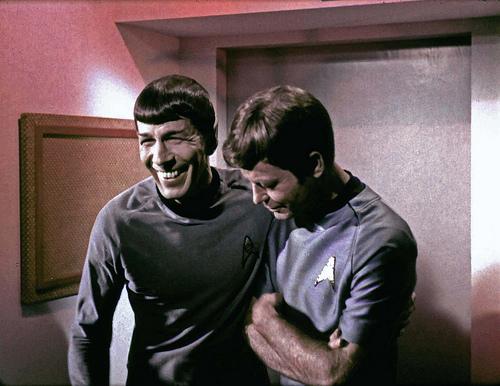
Live Long and Prosper

Reproduced from my old blog in honor of Leonard Nimoy's passing...

When Who Wants To Be a Superhero was first advertised I thought it might be fun to watch an episode or two, but was sure it would be a complete failure. I was partly right. It was a fun show. Mostly juvenile, but not a complete failure

I was brought up by Captain Kirk and Commander Spock to value an archaic-seeming set of principles: loyalty, honesty, justice, mercy, generosity, and honor. I was pleased to see Stan Lee explicitly promoting the same. He has kicked contestants out of "the lair" for not actively displaying courage, kindness, selflessness, and leadership. It would be nice if there were more shows demonstrating honorable behavior, but at least Lee is talking about it.

Addendum: I had four fathers in addition to Kirk & Spock, six fathers in all. My real father taught me about self-sacrifice and service to others. Asimov taught me rationalism. Lewis taught me spiritual awareness, humility, and faith. Heinlein taught me self-sufficiency and liberty. Altogether, I don't think that was a bad combination. It was certainly not the village Hillary had in mind.

The Man in the Axe


Bright sunlight flashed on the wheel-sharpened edge of an iron axe as it arced through a leaf-limned sky and dove down again to bite into knotted, striped flesh. Little green bits of a creeping vine flew away like so many starlings at the rush of a kite. The axe dropped down, came around and up, hovered weightless on the wind before folding its wings and crashing down again. Thunk! And a sound like leaves across sand as a calloused hand slid up the haft and jerked the head free. Down, around, up, woosh, thunk! Again and again, bite after bite, the gap grew wider in the dense wood.

Velkis let the axe head fall to the ground and leaned on the handle. He groaned and twisted around first this way, then the other, every joint creaking, vertebra popping. He extended his right arm and braced his hand against the trunk of the tree, then he turned his body to the left and pushed against the tree, pushed until he the deep scars that wrapped his upper arm like the vines on the trunk of this tree stretched to near tearing. He grimaced as the muscles pulled up tight, but he did not let up until it felt as though the skin might rip apart like the seam on a fat man’s coat. His disfigured arm would never fully straighten again, and the wounds pulled tighter all the time. If he didn’t stretch it every day, the arm would be entirely useless before a year had passed.

He turned his back and leaned against the tree. It remained a sturdy leaning post in defiance of his strength and blade. Many times in the arena Velkis had borrowed strength from the resistance of an opponent, but never had he turned his back on one.

He reached up with his left hand and massaged the stiff arm and shoulder opposite. The hardened, knotted tissue beneath the rigid skin was alternately tender and senseless. The long scar was sunken and white down the center like a glacier-filled valley. Hard, gnarled fingers traced its brown, red, yellow, and puckered borders, weather worn ridges full of hidden defiles. The skin elsewhere was loose and given to the myriad tiny wrinkles which age and the loss of youthful motility had endowed it. Six years in the desert. Five more on the wharfs of Galepileta. Then three decades in the Empire’s arenas. He had witnessed and caused more death than a mouser in a grain house, but the years were beating him down, besting him as it bested all mortals.

Velkis looked up at this old boxwood and wondered now which was he, the tree or the axe? And he wondered if it mattered. The dense wood must surrender to the iron in time, but with each strike the axe grew duller. Rage, though it might, its fate was inevitable: be useless without action or become useless because of it, but the axe, at least, could be sharpened.

The old fighter pushed himself away from the tree, shouldered the axe, and steeled himself to deliver a few more blows before fading light and mounting exhaustion forced him to retire.

Deep breath. Velkis inhaled as he lifted the axe, exhaled as he turned his hips and slid his right hand down the haft, pulling the head down and around with all the force he had left. He felt something was not right in the swing even before the impact—too far from the tree. The toe of the axe bit into the tree where the heel should have struck; the head turned aside, glanced off the trunk, and continued its arc. Far too late to arrest its momentum, Velkis felt the wood turn in his hands, and his heart turn in his chest, and in that eternity between the tree and his shin he had just the time to think No! before the axe collided with his leg.

The shock still rang in the bones of his hands as he gaped uncomprehending at his unharmed leg while his mind labored to interpret the conflicting input. Where there should have been torn flesh, broken bone, and a spreading crimson stain, there was only polished bronze.

“Burn me,” Velkis wheezed and sank to the ground. “Burn it,” he said, louder now, panic giving way, drowning beneath a flood of relief and anger.

He fell on the ground, laughed and struck the earth with his good fist. “Burn it to the lowest, demon lanced hell!” He sent after the first a succession of curses, each more creative and fearful than the last until it became a crude and boyish game. At last he lay still and whispered a prayer of thanks to whatever spirit had reminded him to buckle on those greaves that morning. He turned his head to look up slope toward the peak of Mount Dievakaj.

“Ha!” he scoffed. “You thought you had me with that one, didn’t ya?”

And he remained there, watching the late afternoon clouds drift overhead as he returned, one breath at a time, to the world of mortals, dry throats, and growling stomachs. At long last he pushed himself to his feet, retrieved his axe, and turned his feet toward home and to quiet his stomach.

Ray Bradbury and the Minority Defense League


In light of the recent controversies over the SFWA’s internal censorship policies, consider these excerpts from the author’s afterword to Fahrenheit 451:

“About two years ago, a letter arrived from a solemn young Vassar lady telling me how much she enjoyed reading my experiment in space mythology, The Martian Chronicles.

But, she added, wouldn’t it be a good idea…to rewrite the book inserting more women’s characters and roles?

A few years before that I got a certain amount of mail…complaining that the blacks in the book were Uncle Toms and why didn’t I ‘do them over’?

Along about then came a note from a Southern white suggesting that I was prejudiced in favor of the blacks and the entire story should be dropped….

The point is obvious. There is more than one way to burn a book. And the world is full of people running around with lit matches. Every minority…feels it has the will, the right, the duty to douse the kerosene, light the fuse. Every dimwit editor who sees himself as the source of all dreary blancmange plain porridge unleavened literature, licks his guillotine and eyes the neck of any author who dares to speak above a whisper or write above a nursery rhyme.

Fire-Captain Beatty…described how the books were burned first by minorities, each ripping a page or a paragraph from this book, then that, until the day came when the books were empty and the minds shut and the libraries closed forever….

If the Mormons do not like my plays, let them write their own. If the Irish hate my Dublin stories, let them rent typewriters….If the Chicano intellectuals wish to re-cut my ‘Wonderful Ice Cream Suit’ so it shapes ‘Zoot,’ may the belt unravel and the pants fall….

All you umpires, back to the bleachers. Referees, hit the showers. It’s my game. I pitch, I hit, I catch, I run the bases. At sunset I’ve won or lost. At sunrise, I’m out again, giving it the old try.

And no one can help me. Not even you.

I wonder what Mr. Bradbury would think of an organization of science fiction writers that expels and campaigns against other writers who dare to pen words and ideas that offend some members of some minorities.  Not very much, I suspect.

Here are some other thoughts from prominent SF writers on this topic:

A Morality Tale of One Who Chose Security over Liberty

Protection by Robert Sheckley is a classic Science Fiction short story about a man who was offered protection from every threat, but he didn’t realize until it was too late that protection is itself a real threat.

Where's Our Rocket Packs?

I thought it might be fun to see how far we've come since Daniel Amos sang this song in the early 80s. I was wrong. This was a depressing exercise.  We have lots of gadgets, but Taylor was right that "some things never change".

"(It's the Eighties, So Where's Our) Rocket Packs"
from the album Vox Humana
Words and Music by Terry Taylor
©1984 Twitchen Vibes Music (ASCAP)


It's the eighties
It's the eighties so where's our rocket packs?
Go anywhere, we strap them on our backs
1. (It's the eighties so where's our rocket packs?)
I thought by now I'd walk the moon
And ride a car without no tires
And have a robot run the vacuum
And date a girl made out of wires
No thing's don't change that much, do they?
We are still out of touch, by now we should discover
Just how to love each other, like Klattus' robot man
Your looks have killed again


2. (It's the eighties so where's our rocket packs?)
I thought by now we'd live in space
And eat a pill instead of dinner
And wear a gas mask on our face
A President of female gender
Though progress marches on, (new day)
Our troubles will grow strong
And my expectancies, become my fantasies
You turn my blood to sand, the earth stands still again


My hopes are running low
things moving much too slow
No space men up above
And we're still so very far from love


3. (It's the eighties so where's our rocket packs?)
I thought by now we'd build a dome
Around the world, control the weather
In every house, a picture phone; communicate a little better
But some things never change (replay!)
You are still acting strange
No way that I can see, this way we will be free
La la la la la la,la la la la la 7,6,5,4,3,2,1 Lift off!


(It's the eighties so where's our rocket packs?)
Repeat 1, 2, 3
(It's the eighties)

The Next Generation of Trekkies

I never actually qualified as a Trekkie. I've always been a fan, but never that obsessive. My son just discovered the original Star Trek series and is eating it up. I think that's great, since it's so much healthier than Digimon and the like. However, we watched the first seven episodes, and I was surprised at how suggestive Star Trek was. Much more so than any subsequent spin-offs. It's been years since I've seen it, but I'm pretty sure I didn't pick up on any of that when I was a kid. Our culture has certainly become much more puritanical since then, and definitely not in a healthy way.

C for Could Have Been Great

...but their aim was off. V for Vendetta has a lot of things going for it, but a lot wrong with it too. I have never read the comic books, so understand that my comments refer only to the movie.

Violence. Vendetta is a violent movie. Violence, of itself, isn't always a bad thing. Sometimes it's necessary. Our very civilization is in part built on the idea that some problems must be solved with violence. The police and military carry weapons for that reason, as do many private citizens. Most of us do not see that as a problem so long as those weapons are not abused. Unfortunately, those who intend to abuse their weapons usually do disagree, which is why the German government disarmed its people years before the extent of their depravity became obvious to everyone. It is also why corrupt politicians still use fear to manipulate their people into willingly surrender their weapons today.

The character of V is violent and brutally so. Somewhere in the course of his sufferings, he lost all normal compunctions against the use of violence to accomplish a goal. He is consumed by his hatred and bitterness. Destruction, sadism, and killing are their fruit. In his defense, I must say that brutality sometimes calls for brutality in return. The film-makers don't appear to intend to promote violence, however much they use it to attract viewers. In that, they are simply catering to a market, giving people what they will pay to see.

Terrorism. Terrorism has been defined as the use of violence to induce fear in order to accomplish a goal. Unfortunately, that's a near meaningless definition. All politics is terrorism by that standard. If you don't want your city taking your house to build a shopping mall, there really isn't anything you can do about it anymore. If you try, then men with guns will stop you. They don't really want to shoot you, and probably won't as long as you are fearful enough to stop short of using your own gun. They are, therefore, terrorists. They use violence or the threat of violence to induce fear and compliance in you.

However, there is a fundamental difference between the "terrorism" of V and the terrorism of Hezbollah. V never once targets children or innocent bystanders. He kills soldiers, thugs, and corrupt politicians, all legitimate war-time targets by almost any standards. Hezbollah, on the other hand, deliberately targets the most innocent and unsuspecting people they can find. Even in the special features, the film-makers continuously refer to V as a terrorist, but they are terribly mistaken.

Religion. Religion is portrayed as the rallying cry of the totalitarian government. As a religious man, that rubs me the wrong way a little. But only a little. It is a fact that religion has very often been used as the excuse of power-seekers to root out and persecute dissenters and to rally support for one cause or another. They seldom actually believe their own lies; religion is only their tool. That seemed to be the case here, too. It would have been nice, however, if one or two of the protaganists had displayed an appreciation for true religion.

Homosexuality. There are so many more deserving groups of people the writers could have chosen to champion. Unlike the movie's violence, it was overwhelmingly obvious that the homosexual content was meant to be promotional. It seemed that at every turn homosexuals were lifted up as a persecuted nobility. The writers condemned the preaching of one kind of morality, while serving up their own, which actually runs counter to what has been held by the majority of people in our own society, and indeed throughout the entire world and all its history.

There is nothing noble about homosexuality or its practitioners. Don't get me wrong. I am certain there are some very good people, even noble people, who also happen to be homosexuals. But it is not what they do in bed that makes them noble, and neither does standing up to torture and death for their right to commit sodomy. That just makes them terribly misguided and a poor heroic focus for a film.

I would love to say that V for Vendetta is a great movie, but it's not. It could have been if they had chosen to elevate a persecuted minority whom I could respect. Fahrenheit 451 is great. V for Vendetta is such a disappointment. In fact, because it promotes behavior that my God says should be punished by death, I cannot even allow it into my house again.

Review of the Christ Clone Trilogy

The older I get, the less I enjoy surprises. It isn't so much that I like everything in life to be thoroughly planned and executed, but more that surprises are almost invariably disappointments. The Tribulation Force books surprised me. With all the praise surrounding the series, I expected more than was there. The characters were cookie-cutter heroes and villains and the plot was completely lacking in...well...surprises. It's a good and inspiring story, but its literary quality--or rather its lack of it--disappointed me. And, unfortunately, it's not alone. It is probably a good thing for the genre that there has been an almost unbroken string of apocalyptic films and novels over the last few decades. Without the constant attention, I doubt that many would think twice about the Antichrist or the Mark of the Beast. There certainly hasn't been anything memorable about any of these works individually.

Not like other genres such as romance, which has Gone With the Wind, and westerns, which have The Virginian, and fantasy, which has The Hobbit. Over my relatively short lifetime, I have read thousands of books, most of them science fiction and fantasy novels. Out of all those books there are a very few which I remember clearly--perhaps one in a few hundred. Tolkien's The Hobbit and its accompanying Lord of the Rings Trilogy; Dan Simmons' The Fall of Hyperion; Lewis' That Hideous Strength. Jewels of literature that are completely unforgettable.

That's why I really didn't expect very much when James BeauSeigneur first contacted me about his Christ Clone Trilogy. From the title, it was obviously another end-times, antichrist story. I was certain he had read my last review of an end-times novel, and, believe me, it wasn't flattering. When I saw the publisher's name, SelectiveHouse, I was impressed even less. Who is SelectiveHouse? A low budget job, for sure. The cover graphics didn't boost the books' first impression. But you know what they say about covers.

With a sigh of resignation, I sat down to begin the first of the series, In His Image. By page one sixty-seven, I already knew that I could sum up the entire series in a single word: Surprise! Apocalypse fans, here is your Hobbit. Every turn was unexpected. The characters were real. The plot was real. And never have I seen the Seven Seals broken with such clarity and imagination--if you think you know darkness, think again.

In His Image follows the life of Decker Hawthorne through the historical examination of the Shroud of Turin in 1978, three years as the hostage of Lebanese terrorists, the Disaster and the ensuing oscillations of the world through chaos, peace, and to chaos again. But to focus on Hawthorne's life is to see only one of many levels of plot. Several years after the trip to Italy, a scientist discovers live skin cells on a sample taken from the Shroud. Cloning these cells results in discoveries that lead to treatments for cancer, AIDS, and many other diseases. It also leads to Christopher Goodman.

Goodman is one of the few characters that take time to become real. At first he was very two-dimensional. With a few exceptions, his actions and dialogue were predictable. But as you watch him grow up--the first book covers a span of about 33 years--he becomes genuinely likeable. He seems a good man, through and through.

There are several characters I instinctively distrusted. Robert Milner, a New Age mystic and the Assistant Secretary-General of the United Nations, and Jon Hansen, the Secretary-General, come immediately to mind. But a hallmark of a superior writer is the ability to make you see the good in the bad guys and the bad in the good guys. It's difficult for me to imagine sympathizing with anyone who would promote the United Nations, but by the end of the book I was pleasantly surprised to be thinking of Jon Hansen in the same light as Dag Hammerskjold. How do such good men come to such power in such corrupt organizations?

But the surprises don't end there. In His Image holds surprises in the characters and in their individual stories. The second book, Birth of an Age, holds surprises of a different sort. The fulfillment of the prophecies of Daniel, John, and others begin coming at a faster pace, but rarely in the form I expected. The Seventh Sign, The Stand, The Omen, and Rosemary's Baby all stand out for their complete disregard of Biblical prophecy. Tribulation Force tries to remain Biblically true, but fails for lack of depth and imagination. BeauSeigneur has no problem in either department. You can follow along in John's Revelation, but you will still not know what's coming next. Every prophecy is fulfilled in ways I would never have expected, but that, in retrospect, make so much sense. I won't pretend to be a prophecy expert, but if you subscribe to evangelical eschatology--or for that matter, even if you don't believe in prophecy at all--you won't be able to stop reading. I read the first book in about one week. I read the second book in one night, and the third, Acts of God, in another night.

Birth of an Age kept me guessing as to who were the good guys and who were the bad guys. Acts of God left no doubt. While a little wordy at times, it was fascinating to watch all the threads come together into this complex tapestry. With vast portions of the planet completely uninhabited after two nuclear wars and a series of astronomical disasters, the Beast is finally revealed.

BeauSeigneur is not a perfect writer. His form and structure isn't perfect. His characterization isn't perfect. But it's so close you might not even notice. These are some of the few books about which I can honestly say, "Wow!"

-jay carper, January 17, 2000

SelectiveHouse Publishers can be found at www.selectivehouse.com or at P.O. Box 10095, Gaithersburg, Maryland 20898, or by calling 1-800-CLONE-99 (orders only, please).